Originally published July 14, 2020. Fully rewritten and updated with current timelines, our real process, and a Phoenix kitchen project example.
If you've put off your kitchen remodel partly because you dread living through it, that hesitation makes sense. The disruption is real, and most people know someone whose remodel went sideways.
The Short Answer
A kitchen remodel turns stressful for two reasons: you can't see what's coming, and you're not sure the team you hired will handle it well. Remove those two and most of the stress leaves with them. The fix is working with one company that designs and builds the project, puts a fixed price in writing before demolition, and keeps you with the same people from the first conversation to the final walkthrough.
Here's where that stress comes from, and how the right process takes it off your plate.
What makes a kitchen remodel stressful?
Almost none of it is the construction itself. Homeowners rarely lie awake over drywall. What wears on people is not knowing what happens next, and wondering whether the people they hired are actually handling it.
The not-knowing is its own weight. When you can't picture the sequence or the timeline, every noise from the kitchen becomes a question. Is this normal? Are we behind? Should someone have told me about this? A remodel run without a clear plan leaves you to fill those gaps yourself, usually with the worst guess.
The second source is the team, and it is the one that does real damage. You have probably heard the stories, or lived one: the price that climbed after the contract, the timeline that kept sliding, the person who was hard to reach the moment the demolition dust settled. That is contractor roulette, and it is the fear most homeowners carry into the first phone call, whether they say it out loud or not.
Notice what is missing from that list. Not tile. Not cabinet hardware. The stress is about certainty and trust, not the work. Which is the good news, because both can be built into how a project is run from the start. The rest of this comes down to a process designed to remove the unknowns and a team you do not have to manage.
How long does a kitchen remodel take?
Plan on roughly four to eight months from your first design conversation to the final walkthrough. Knowing that number upfront removes the single biggest source of remodel stress, because most of the worry comes from not being able to see the shape of the project. So here is the shape.
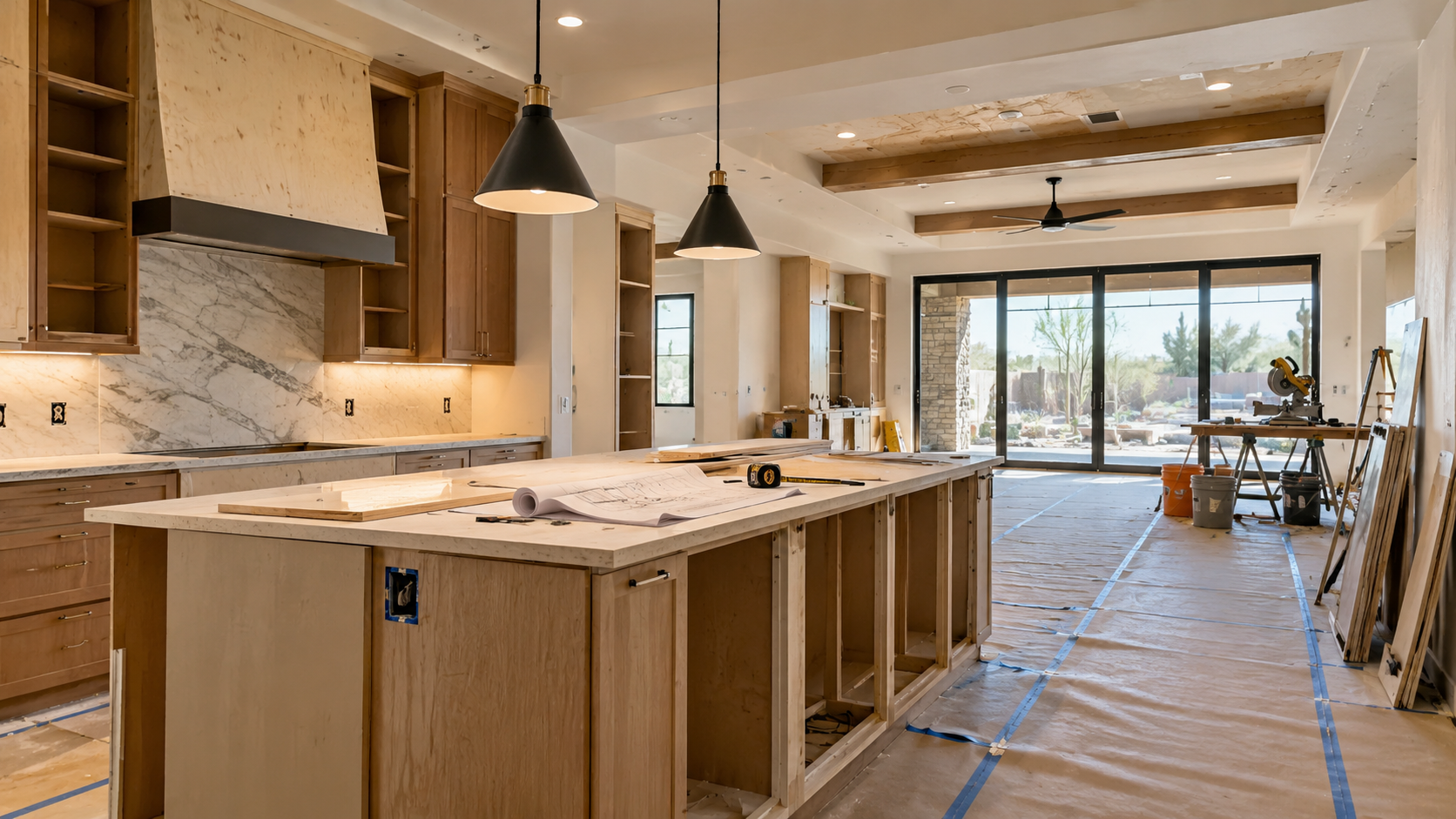
The work moves through three stretches. Design and planning takes one to three months, where the layout, the selections, and the fixed price all get settled before anyone picks up a tool. Then comes a materials window of one to two months, because the pieces that make a kitchen, cabinets especially, are built to your specifications and take time to arrive. Construction itself runs seven to twelve weeks.
That materials wait surprises people, so it is worth saying plainly: a real share of your timeline is waiting on cabinets, not hammering. We order early and schedule the build around actual arrival dates, so the crew is not standing in a torn-up kitchen waiting on a delivery.
We also build padding into the schedule from the start, then tighten it as we go. Early on, a stage like drywall repair gets blocked out for a few days as a placeholder. As that point gets closer and we can see exactly when the trades ahead of it will finish, we pin the real day and adjust to the actual work in front of us. That is why a small slip earlier on, a tile crew needing an extra day to close out another job, usually does not move your finish date.
Most of the timeline happens before demolition
Design & planning
1 to 3 months
selections locked
→
Ordering & materials
1 to 2 months
cabinets take longest
→
Construction
7 to 12 weeks
demolition to walkthrough
First conversation to final walkthrough
roughly 4 to 8 months
Should you stay in your home during the work?
Most of our clients stay, and a kitchen remodel is usually livable as long as you plan for the obvious thing: you will be without a kitchen for a stretch. That is the part to prepare for, not the part to fear.
What makes staying workable is how the site is managed. We seal the kitchen off from the rest of the house with dust barrier walls, so the mess stays contained instead of drifting into your living room. Where the layout allows, the crew comes and goes through a back door, a side gate, or the garage, which keeps the daily foot traffic out of your main living areas. And we set up a temporary kitchen before demolition begins, usually the refrigerator relocated nearby with a folding table for a microwave, so you always have a way to eat at home.
None of that erases the inconvenience. It contains it. If losing the kitchen for a couple of months sounds like more than you want to live through, moving out for part of the project is a reasonable choice, and we will help you plan around it. Most people find that with the space sealed off and a real plan in place, staying is easier than they expected.
Living through a remodel is a big enough question that we gave it its own guide: Can I live in my home during a remodel?
Who's in charge while your kitchen is torn apart?
One person. From the day construction starts, you have a field superintendent, sometimes called a project manager, who runs your job and is your point of contact. You are not routing questions through an office or wondering which subcontractor to chase down. There is a name and a number, and it belongs to the person actually standing in your kitchen.
That superintendent checks in with you every working day during construction. You hear what happened, who was on site, and who is coming tomorrow. It sounds like a small thing, and it changes the whole experience, because the stress was never really about drywall. It was about being left in the dark. When you know what today held and what tomorrow brings, the guessing stops, and most of the worry goes with it.
It also means problems surface early. If a delivery is running late or a decision is needed from you, you hear it from one accountable person while there is still time to handle it calmly, instead of finding out after the fact.
How do selections and pricing work, so there are no surprises?
This is the part that removes the second big stressor: the fear that the price you were quoted is not the price you will pay. With us, your materials and selections are settled during the planning phase, before demolition ever starts. Because every choice is locked in first, we can put a fixed price in writing up front. The number you approve is the number you pay, unless you choose to change something along the way.
It also means you are not sent to run all over town, comparing a hundred suppliers and second-guessing every finish. We narrow it down. We bring you suggestions and a workable set of choices that fit the kitchen you described, and we help you decide. You stay in control of how your kitchen looks and feels, without drowning in options or wondering whether you missed a better tile three showrooms away.
The advice you will read elsewhere is to hand your contractor a list and have them buy the materials. That gets the order of operations backward. When selections come first and the price is set in writing before the work begins, there is nothing left to renegotiate mid-project, which is where so much remodel stress, and so many blown timelines, come from.
What a calm kitchen remodel looks like
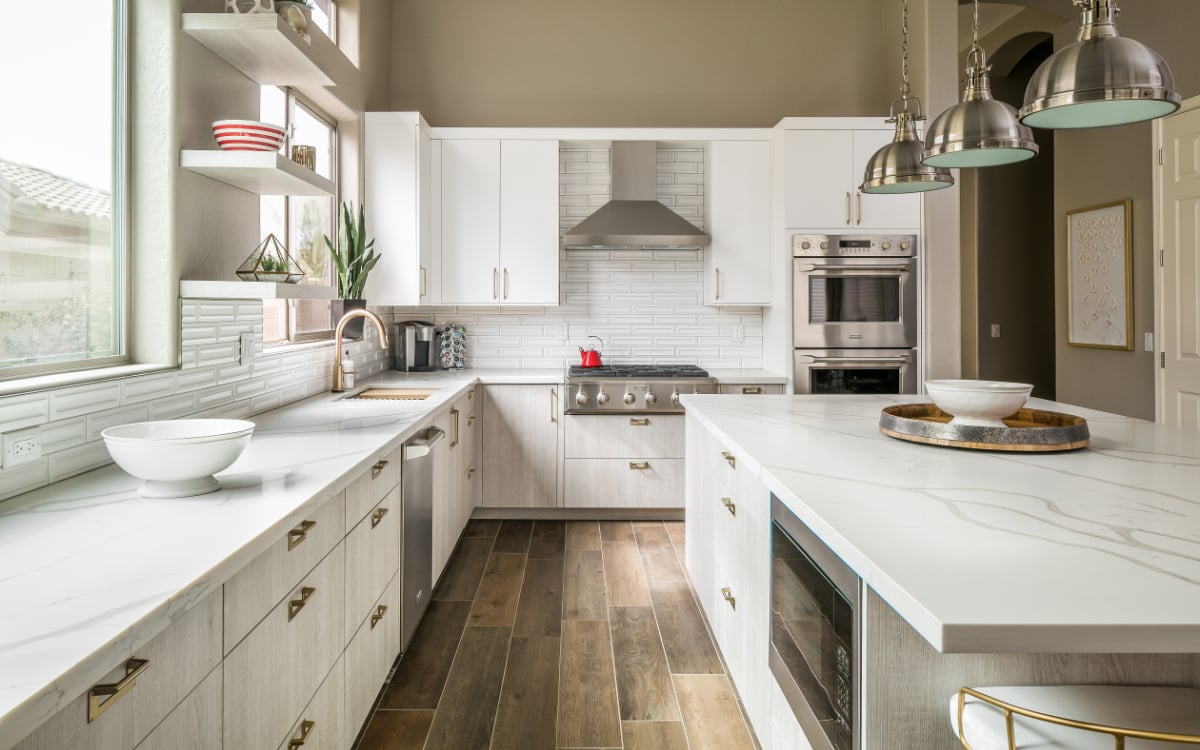
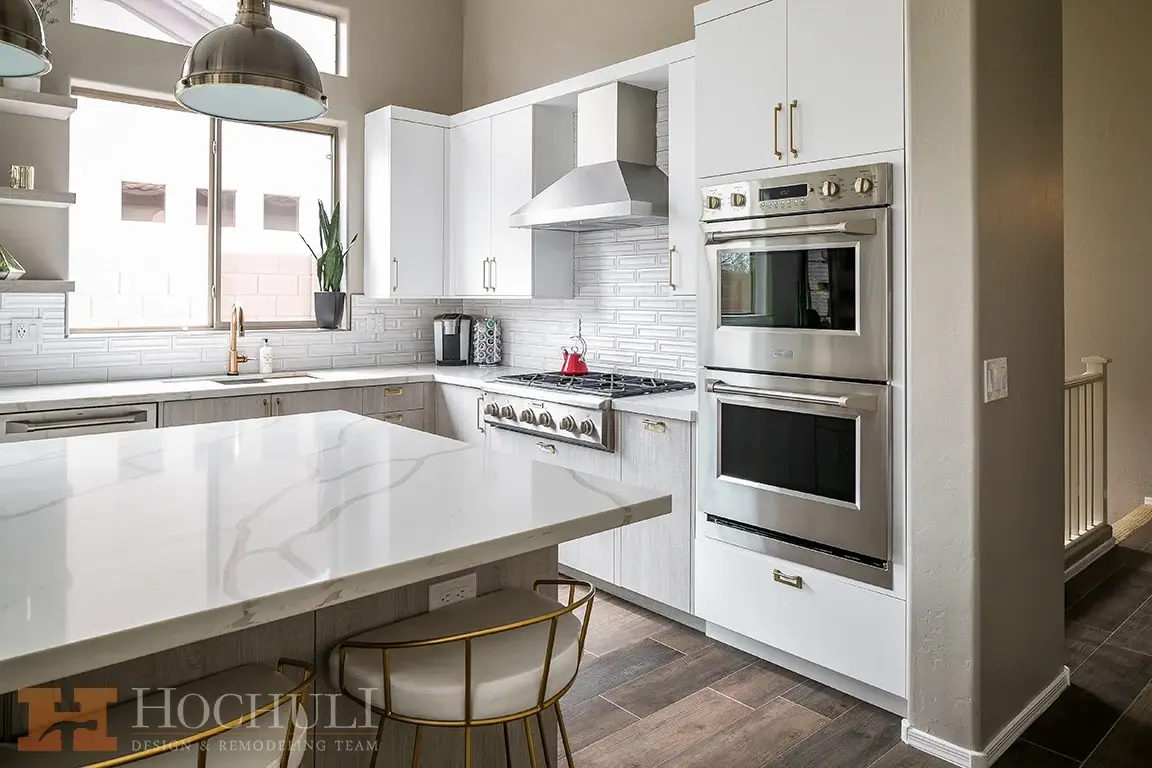
A couple of years ago we remodeled a kitchen in Tempe for a homeowner named Judy. Before we started, what worried her was not the design. It was the disruption: the chaos of a torn-up kitchen, the stream of tradespeople in and out of her house, and the stretch of time she would spend without a working kitchen.
So that is what we built her experience around. The kitchen was sealed off from the rest of the house, and the crew used the back door and the yard as their way in and out, so her days were not filled with foot traffic through her living space. Every day, her field superintendent sent a recap: what got done, and who would be on site the next morning. Even the temporary setup was handled before demolition began, with her refrigerator moved to the adjacent living room and a microwave on a folding table, so normal life had somewhere to happen.
The part that mattered most was the timeline holding. The signed agreement estimated the build would run from April 1 to May 16. The actual work ran April 7 to May 14, finishing two days ahead of the completion date we had put in writing. About five and a half weeks from demolition to final touches, landing right where we said it would.
Here is how Judy put it afterward:
"I can't say enough about the quality of my experience with the Hochuli Design team. Every aspect of the project was thorough, professional and on time. Communication was excellent, and the finished project was exactly what I had imagined. Thank you Scott, Lorrie and the rest of the team!"— Judy S., Tempe
That is what removing the unknowns and staying in daily contact actually buys you. Not a remodel with no dust, but a remodel that never became the thing she was afraid of.
How do you know you've got the right team?
The right team is the one that takes the managing off your plate instead of adding to it. You should not have to referee between a designer and a builder, track down who ordered what, or become a construction expert just to protect yourself. A few things are worth checking before you commit, and a trustworthy firm makes every one of them easy.
Confirm the license. In Arizona, a remodeler should hold a current ROC license in good standing, and you can verify it yourself with the Arizona Registrar of Contractors. A firm that hesitates when you ask for its license number has answered the question.
Read the reviews closely. Not the star average, the specifics. Look for recent projects like yours and how problems got handled, because how a team behaves when something goes wrong tells you more than a wall of five-star blurbs. Ours are public, so read them yourself.
Ask for the price in writing. A firm comfortable putting a fixed number on paper before demolition is one that has done the work to know what the project costs. You can see our real Phoenix kitchen ranges on the kitchen remodel cost page. If pricing only firms up as the job goes, the stress you were trying to avoid is already built in.
Then there is the honest part. We are not the right team for everyone. If the goal is the lowest bid, or a mostly do-it-yourself project with a contractor on call for the hard parts, we are not your firm, and we will tell you that early. Our best clients would rather hand the whole thing to one accountable team and get their weekends back. They are not bothered by paying for that, because they understand good work takes committed partners on both sides.
Frequently asked questions
How long does a kitchen remodel take?
Plan on roughly four to eight months from your first design conversation to the final walkthrough: one to three months of design and planning, one to two months waiting on materials like cabinets to arrive, and seven to twelve weeks of construction.
Can I stay in my home during a kitchen remodel?
Most homeowners do. It's livable when the kitchen is sealed off from the rest of the house and a temporary kitchen is set up before demolition begins. If being without a kitchen for a couple of months sounds like more than you want, moving out for part of the project is a reasonable choice. Our full guide walks through both options.
How do you keep the price from changing partway through?
Your selections are finalized during the planning phase, before demolition. Because every choice is locked in first, we put a fixed price in writing up front, and the number you approve is the number you pay unless you decide to change something along the way.
Do I have to pick every material myself?
No. We narrow the options down for you, bringing suggestions and a workable set of choices that fit the kitchen you described. You stay in control of how it looks without visiting a dozen showrooms or second-guessing every finish.
Ready When You Are
Still deciding? That's a fine place to start.
You don't have to be ready to break ground to start a conversation. If you're still weighing whether a kitchen remodel is worth it at all, the most useful next step is to talk it through with someone who has done it many times. There's no pressure to commit to anything.
When you are ready, that first conversation is exactly that, a conversation and not a sales call. You'll leave knowing more than you came in with, whether or not we ever work together.
Twenty minutes, at a time that works for you. No obligation.

 Scott Hochuli