Scott Hochuli
- The real question is not whether you can stay. It is which weeks you need to leave.
- Why a working bathroom, not project size, decides it.
- What living at home cost one Chandler family: two to three extra weeks of schedule.
- What they said when we asked if they would do it again.
Last updated July 2026
Yes. Most Phoenix homeowners can live at home through a remodel, and most of ours do. But the question that matters is not whether you stay. It is which weeks you leave. Plan to be out for heavy demolition and for the days your floors go in, which is usually two to three weeks across the whole project. What decides the rest is plumbing. If the work takes your last usable bathroom offline, you are leaving, no matter how small the job looks on paper.
Scott Hochuli, Founder, Hochuli Design & Remodeling Team. Founded 2001. Runtime 1:36.
Read the transcript
Can you live in your house while we remodel it? Yes, and most of our clients do. But I tell people the truth about it, which is that it's like camping. You can absolutely do it. It's just uncomfortable. And the real question isn't whether you stay, it's which weeks you leave. Plan to be gone for heavy demolition. Plan to be gone when the floors are going in. That's usually two to three weeks across the whole project. And if you know that upfront, you can plan around it instead of scrambling.
What decides the rest sometimes is the plumbing. If the work takes your last usable bathroom, you're leaving. Doesn't matter how small the job looks on paper.
We did a whole house in Chandler, 2,800 square feet, kitchen gutted, both bathrooms down to the studs, every inch of flooring replaced, whole interior repainted. The family stayed for most of it. Refrigerator in the garage, folding table for the microwave, rug on the garage floor so they had somewhere to eat dinner.
That project ran 12 weeks. It probably should have run nine, maybe 10. Those extra weeks were the cost of them staying, and we ate them. Their price didn't change. Their calendar did. I asked them afterwards if they'd do it the same way and they said yes. They said it was uncomfortable too, but the money they didn't spend on a rental went into their house remodel instead. And to them, that was worth it.
That's the honest version. Staying isn't free and it isn't easy. For a lot of families, it's still the right call. Everything I just said is written out below along with what to ask any contractor before you decide. When you're ready to get serious, let's start the conversation.
Why "how big is the project?" is the wrong question
Most people decide this by looking at the size of the job. A bathroom sounds survivable. A whole house sounds like you are moving out.
That instinct is wrong in both directions.
We have taken a 2,800 square foot home in Chandler down to studs in the kitchen and both bathrooms, replaced every floor and every baseboard, and repainted the entire interior, with the homeowners living there for most of it. Meanwhile, a single bathroom can force you out of the house, if it is the only bathroom you have. There is no version of that project where you are showering at home.
Size is not the constraint. Plumbing is. What decides this is not how much work is happening. It is whether you still have a bathroom you can use and a way to feed yourself while it happens.
How long will you actually be living like this?
Before you can decide anything, you need to know what you are deciding about. Two weeks of disruption is an inconvenience. Five months is a way of life.
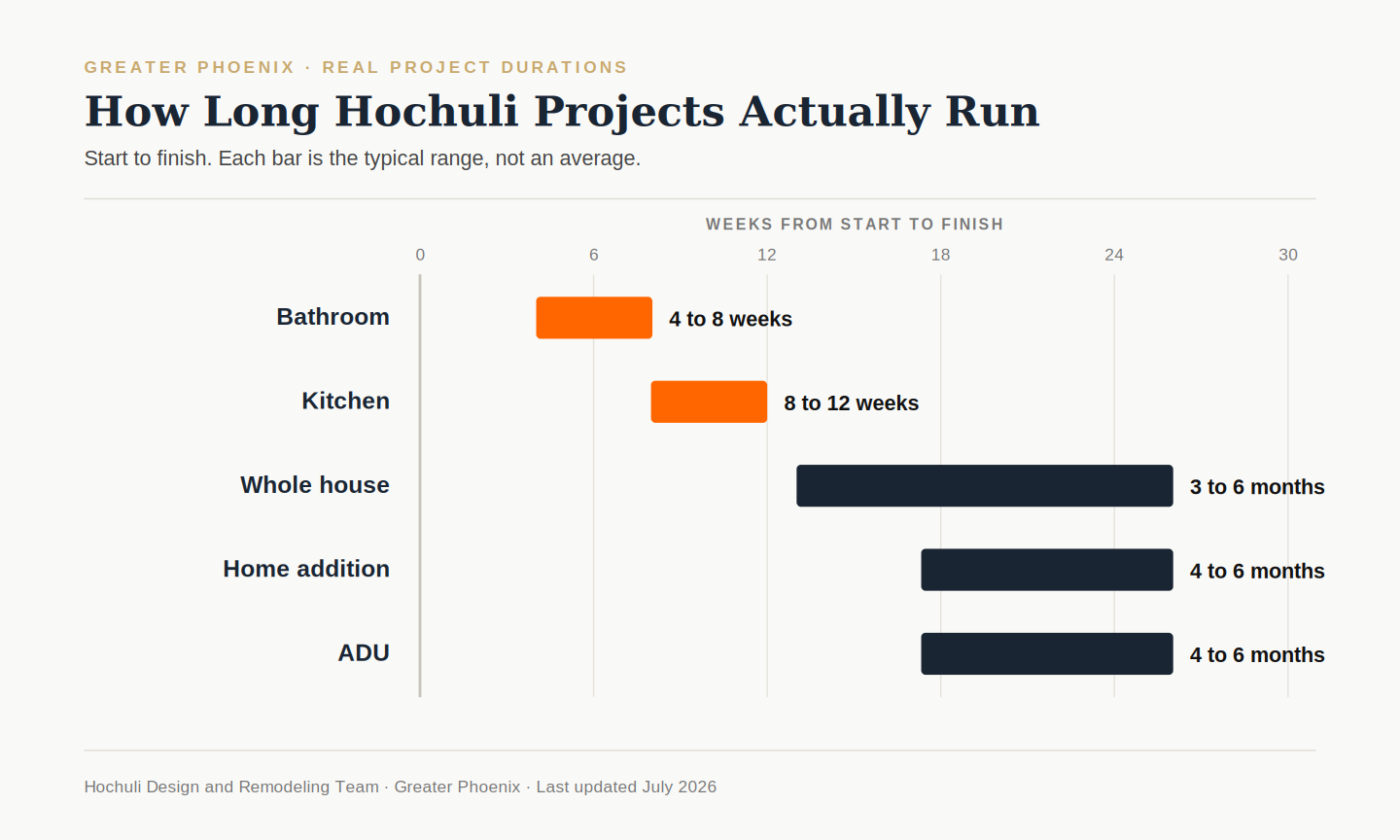
Here is what our projects actually run in the greater Phoenix area, start to finish:
| Project | Typical duration |
|---|---|
| Bathroom | 4 to 8 weeks |
| Kitchen | 8 to 12 weeks |
| Whole house | 3 to 6 months |
| Home addition | 4 to 6 months |
| ADU | 4 to 6 months |
These are real ranges from real projects, not industry averages.
Now look at those numbers again and ask the honest question. A bathroom at four to eight weeks is a season. A whole house at three to six months is most of a year of your life, and you are going to be inside it.
That is the number that should drive this decision. Not the demolition. The duration.
When you can stay
Scott tells homeowners that living in your house during a remodel is like camping. You can absolutely do it. It is just uncomfortable.
That is the honest frame. Not "you will barely notice we are here," which is what someone will eventually tell you, and it is not true. You will notice. The question is whether you can live with it.
You can stay if you can answer yes to all four of these.
You have a bathroom you can use without walking through the work
Not a bathroom that will be finished soon. One that works, today, for the whole project. If we are remodeling two bathrooms and you have a third, we sequence them one at a time so you always have a shower. If you have exactly one bathroom and it is in the scope, that answer is no.
You have somewhere to put a refrigerator
A kitchen remodel does not mean living on takeout for three months. It means moving the refrigerator somewhere else and living simply for a while. A garage works. So does a dining room.
You can be out for the worst weeks
Heavy demolition is loud, filthy, and not worth being present for. Flooring is worse, because we need the rooms empty. Plan to leave for those. If you cannot leave for any of it, staying gets much harder.
You are honest with yourself about noise
Crews arrive early. Tile saws are loud. If someone in the house works from home or sleeps during the day, that is not a dealbreaker, but it needs to be a conversation before we start, not a discovery in week two.
If all four are yes, you can almost certainly stay. Most of our clients do.
When you should leave
If the project takes your only bathroom, you are leaving
This is not a preference. There is no clever workaround, and any contractor who tells you otherwise is hoping you will not think about it until the shower is gone.
If we are moving plumbing in a slab home, expect it to get loud and slow
Phoenix houses are built on concrete slabs. Relocating a drain means cutting into that slab, and it is one of the most disruptive things we do inside a house. It is also one of the biggest cost drivers on a bathroom remodel in Phoenix. If your project moves plumbing and you have somewhere else to be, go be there.
If the work is happening in the only place you can be
A whole house remodel in a 1,400 square foot home is a different experience than the same remodel in a 2,800 square foot one. It is not about the scope. It is about where you go while the scope is happening.
If you cannot afford the time
Living at home slows the work down. Our Chandler project ran two to three weeks longer than it needed to, because the crew was working around a family. Your price does not change. Your calendar does. If there is a date you need to be finished by, staying is working against you.
If you know yourself
Some people can live with dust and noise and a folding table in the garage. Some people cannot, and there is nothing wrong with that. Six months is a long time to find out you are the second kind.
What it actually looks like day to day
Here is the part most contractors will not describe, because an accurate description makes the job sound harder than they want it to sound.
The work has a footprint, and it is bigger than the room
A kitchen remodel is not confined to the kitchen. Crews need a way in and out. Materials need somewhere to sit. Tools need a staging area. Ask, before construction starts, which rooms will actually be affected and which doors the crew will be using. You may find that what looked like one room is really three.
Dust is contained, not tolerated
We seal off active work with ZipWall poles and plastic sheeting, using magnetic doors so the crew can pass through without opening the barrier every time. When we gutted the primary bathroom in Chandler, that room was isolated from the rest of the house. Dust control is not a courtesy. It is a system, and you should ask any contractor to describe theirs before you hire them.
Finished work gets protected immediately
New floors go under Ram Board the day they are installed. New cabinet fronts get covered in cardboard. New countertops get covered too. New fixtures go in and are off limits to the crew until the project is done. The house is being built around you, and none of it is allowed to get damaged on the way.
We work room by room, on purpose
In Chandler, we remodeled one bathroom at a time so the family always had a working shower. When we got to the laundry room, the crew pulled the washer and dryer to work, then reinstalled them every Friday so the family could do laundry on the weekend.
Your life gets designed around, not paused
One of the Chandler homeowners worked from home. Her front bedroom office was sealed off with sheeting and a magnetic access door so she could keep working through construction. When it was time to replace the floor in that room, the crew took her desk apart, moved it out, laid the floor, repainted, and put her workspace back together.
None of that is glamorous. All of it is the difference between living in a construction site and living in your house while it is being remodeled.
A Chandler family who stayed, and what it cost them
The house was 2,800 square feet. The project was close to everything: the kitchen gutted, both the primary and hall bathrooms taken down to studs, new flooring and baseboard through the entire house, the whole interior repainted. The primary bathroom got new windows and a larger shower. The hall bathroom got new cabinets, counters, sinks, fixtures, shower walls, a new tub, and new flooring.
They stayed for most of it.
The refrigerator moved to the garage. A folding table went next to it for the microwave and the toaster oven. The crew put a rug down on the garage floor and set up their dining table and chairs on it. That was the kitchen for the better part of three months.
They left twice. Once for a week during heavy demolition, and once for a week when the floors went in.
The floors were the hard part. We could only work on about a third of the house at a time, which meant moving the family's furniture onto the newly finished floor so we could tear out the next section. Then moving it again. Then again.
The project ran twelve weeks. It probably should have run nine or ten. Those extra two to three weeks were the cost of the family staying, and the cost was paid in time, not dollars. Their price did not change. Their calendar did.
We asked them afterward whether they would do it the same way.
They said yes. It was uncomfortable at times, and they said that too. But the money they did not spend on a rental house went into the remodel instead, and to them that trade was worth it.
That is the honest version of this decision. Not that staying is free. Not that it is easy. That it costs something real, and that for some families the trade is worth making.
If you are staying: what to set up before day one
Everything here is easier to do before the work starts than after. Once the house is torn up, your options narrow fast.
Build the temporary kitchen somewhere real
Not a corner of a room you also need. Move the refrigerator, give yourself a surface for the microwave and toaster oven, and put a table where you can actually sit down and eat. The Chandler family used their garage and put a rug down. It sounds like a small thing. It is the difference between eating dinner and standing over a counter.
Know which bathroom is yours for the duration
Confirm it with your contractor before demolition, not during. If the answer is complicated, that is worth knowing now.
Get your valuables out
Anything seasonal, fragile, or irreplaceable should be out of the house before the crew arrives. Not because we are careless, but because you are about to be living in a smaller footprint and every square foot counts. A storage unit costs very little. A broken heirloom costs you something you cannot buy back.
Make a plan for kids and pets that does not rely on a closed door
A closed door is not a barrier. A dog will find its way into a room with exposed nails, and a curious kid will do it faster. Ask where the sealed zones will be and set up the parts of the house that stay normal, so there is somewhere for them to just be.
Book the weeks you are leaving now
Demolition and flooring. Ask your contractor when they land and put them on the calendar early. Scrambling for a hotel three days out is worse than planning for it three months out.
Protect one routine
Not all of them. One. The Chandler crew reinstalled the washer and dryer every Friday so the family could do laundry on the weekend. Pick the thing that would make you feel like a person, tell your contractor, and let them build around it.
Do not add anything else to your life right now
This is not the season for a big vacation or hosting the holidays. The remodel will take more of your attention than you expect. Give it the room.
If you are leaving: what nobody tells you it costs
Moving out is the clean answer. It is not the free one.
A rental is not the only cost
You are paying rent, but you are also paying deposits, and you are moving twice. Movers, boxes, and a storage unit for the furniture that will not fit in the rental. Then all of it again on the way back.
Utilities do not pause
Your house still has a power bill, a water bill, and insurance while nobody is living in it. Now you have a second set on top.
Short-term leases carry a premium
A landlord who will take you for three or four months prices that flexibility in. Furnished is more. Pet-friendly is more.
Distance costs you something too
If you move across town, your kids may still need to get to the same school and you may still need to get to the same office. If you move somewhere less expensive and further out, you pay for it in your calendar every day.
Some of our clients have a second home, which changes this math entirely. If you have somewhere to go that you are already paying for, moving out is close to free and staying makes very little sense. Most people are not in that position.
That is the honest comparison. Staying costs you comfort and, sometimes, weeks. Leaving costs you money. Neither one is the obvious answer, and anyone who tells you it is has not looked closely at your situation.
What to ask your contractor before you decide
You cannot make this decision alone, and you should not have to. Most of what you need to know lives in your contractor's head, and a good one will tell you without being pushed.
Ask these before you sign anything.
Which rooms will actually be affected, and which doors will your crew use?
The work has a bigger footprint than the room. Find out what it is.
How do you contain dust?
Ask them to describe the system. If the answer is a bedsheet taped over a doorway, you have learned something important.
Which weeks are the bad ones, and can you tell me now?
Demolition and flooring, usually. A contractor who has done this before can tell you roughly when they land. One who cannot may be guessing at the schedule generally.
Can you sequence the bathrooms so we always have a shower?
If you have more than one bathroom in the scope, this is the single most important question in the list.
What do you do to protect the work that is already finished?
New floors, new cabinets, new counters. Ask what happens to them while construction continues around them.
Will us living here slow you down, and by how much?
Ask it directly. If the answer is "not at all," be skeptical. It will. The right answer is an honest estimate, not a reassurance.
What happens to my laundry?
It sounds small. It is not. It is a good test of whether they have thought about you living here at all.
If a contractor cannot answer these, that is your answer.
Common questions
Can you live in your house during a kitchen remodel?
Usually, yes. A kitchen remodel runs 8 to 12 weeks, and the constraint is not the kitchen itself. It is whether you have somewhere else to put a refrigerator and a place to sit and eat. A garage works. Most of our kitchen clients stay. If you are still working out the numbers, our kitchen remodel cost page for Phoenix has the real ranges.
Can you live in your house during a bathroom remodel?
Only if you have another bathroom you can use. A bathroom remodel runs 4 to 8 weeks. If it is your only bathroom, you are leaving. If you have two and only one is in the scope, you will barely notice.
Can you live in your house during a whole house remodel?
Yes, and our clients do. A whole house remodel runs 3 to 6 months, which is a long time to live inside a construction site. It is doable when the house is big enough to give you somewhere to be and when the bathrooms can be sequenced so you always have a shower.
How long will I have to move out for?
Plan on two to three weeks total, not consecutive. Usually one week for heavy demolition and one week for flooring. Ask your contractor when those land so you can plan around them.
Will living at home make my remodel take longer?
Yes. Working around a family means moving furniture, working in smaller sections, and stopping to protect things. Our Chandler whole house project ran twelve weeks instead of the nine or ten it should have taken. The price did not change. The schedule did.
Is it safe to have kids or pets in the house during construction?
Not in the work zones, and a closed door is not enough. Active construction areas should be sealed with real barriers. Set up the parts of the house that stay normal, and keep kids and pets there.
What about dust?
Ask your contractor to describe their system before you hire them. We use ZipWall poles and plastic sheeting with magnetic doors, so active work is isolated from the rest of the house. Dust control should be a system, not a promise.
So, can I live in my home during a remodel?
Yes. Most people can, and most of our clients do.
But do not decide it the way most people decide it, by looking at the size of the project and guessing. Look at your bathrooms. Look at where the refrigerator goes. Look at the two or three weeks you will need to be somewhere else, and figure out where that somewhere else is.
And be honest with yourself about the camping part. It is uncomfortable. The Chandler family said so, and they would still do it the same way.
If you are working through this, a few other things worth reading: our whole house remodel cost page will tell you what these projects actually run in Phoenix, and if you are still deciding whether to remodel at all, Should I Move or Remodel? is the honest version of that question.
When you are ready to talk it through with someone who has done this a few hundred times, we are here.
Let's start the conversationRelax. You're in safe hands.
 Lorrie