The rules for building an ADU in Arizona changed. Here's what you can actually build on your lot.
Arizona passed House Bill 2720 in 2024 and HB 2928 in 2025. Between them, the rules for accessory dwelling units across the state were rewritten. Most homeowners researching an ADU today have no idea what their city actually allows, what their HOA can still block, or what the rental income rules look like.
So we put together this guide. Plain language. City by city. No legal jargon and no sales pitch buried in it. The same explanation we'd walk you through if you sat down with us before spending a dollar on design.
Most homeowners researching an ADU don't realize how much the rules just changed.
Most homeowners who find this page have been thinking about adding a casita, guest house, or backyard ADU for a while. Maybe for a parent moving in. Maybe for a college-age kid. Maybe for rental income while Phoenix housing prices stay where they are. Maybe just for a quiet detached office that isn't the kitchen table.
You've probably done some reading by now. You've seen the terms "HB 2720" and "HB 2928" come up. You've maybe heard that ADUs are easier to build than they used to be. You've also maybe heard that HOAs can still block them, and you're not sure which rule wins.
This page sorts that out.
What you'll find here is a plain-language walk through what an ADU actually is under Arizona law, what changed in 2024 and 2025, what each of the seven major Phoenix-area cities allows (Phoenix, Scottsdale, Tempe, Chandler, Gilbert, Mesa, and Paradise Valley), how to know if your specific lot will work, what the HOA reality looks like, and how the rental income rules actually function. No legal jargon, no sales pitch tucked into the middle of it, and no claims that the rules are simpler than they are.
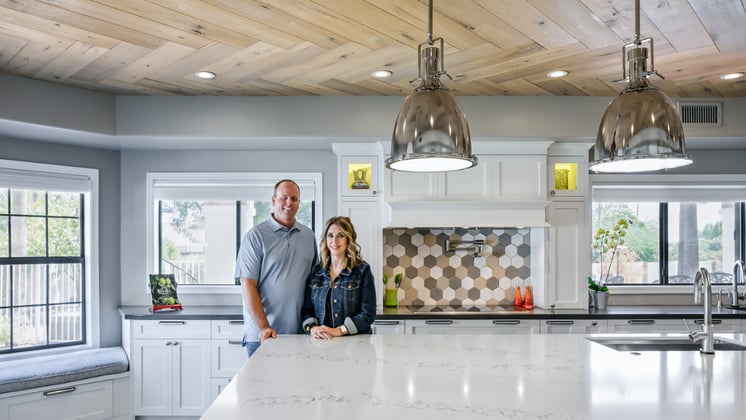
When you're ready to look at what an ADU actually costs to build, our ADU Cost in Phoenix page covers that in detail. When you're ready to talk through your specific lot and situation, you'll meet Scott and Lorrie Hochuli (pronounced Ha-Cue-Lee), the founders. The Hochuli team has built design-build remodeling projects across the greater Phoenix metropolitan area since 2001.
Scroll at your own pace, and find the next step at the bottom for when you're ready to start the conversation.
What counts as an ADU under Arizona law (and what doesn't).
The legal definition is shorter than most people expect.
Under Arizona Revised Statutes § 9-461.18, an accessory dwelling unit is a self-contained living unit on the same lot as a single-family dwelling, with its own sleeping facilities and its own sanitation facilities. The law says an ADU "may include its own kitchen facilities," which means a kitchen is allowed but not required to meet the definition.
In plain language: a place to sleep, a bathroom, and access to the same lot as the main house. That's the floor. Most ADUs include a kitchen or kitchenette, but the law doesn't require one.
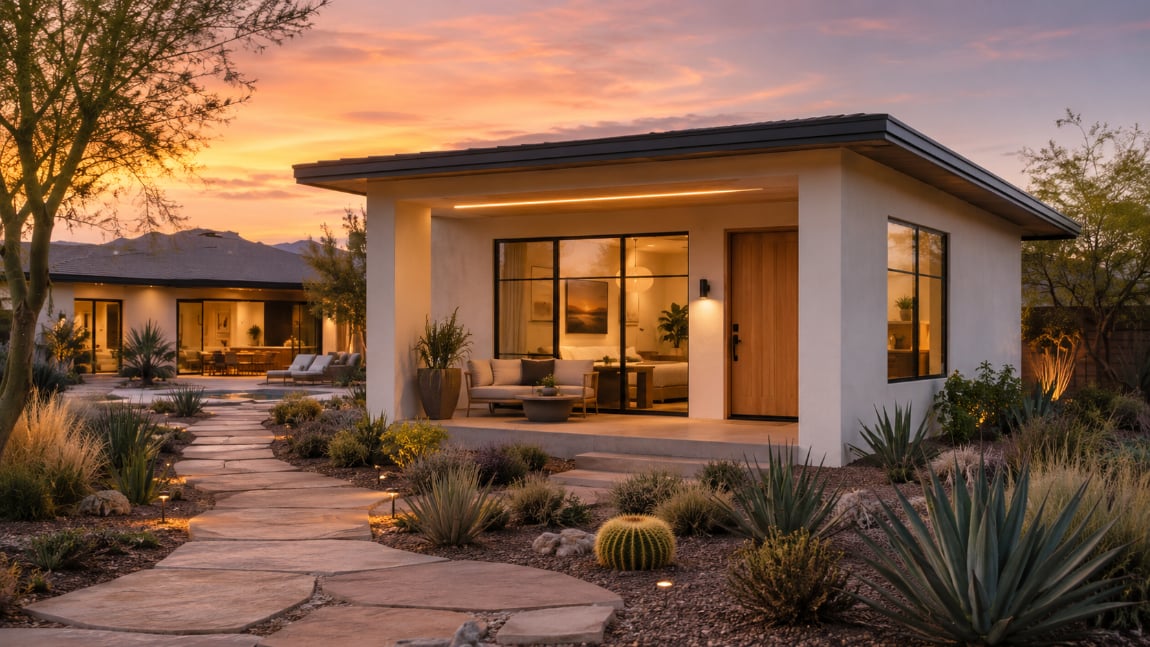
The structure can be attached to the main house, sit in the backyard as a detached building, or be a converted garage. All three count as ADUs as long as they meet the dwelling-unit criteria. Arizona homeowners often use the words "casita," "guest house," "in-law suite," or "backyard cottage" interchangeably with "ADU." Legally, they're all the same thing if they meet the definition above.
The four paths to building an ADU
Detached new build
A new standalone structure built from foundation up, sitting separately in the backyard. The most common path for a true backyard casita. Highest cost because you're building a complete envelope, but the most flexibility on layout, finish, and how separate the space feels from the main house.
Attached new build
A new addition off the side or back of the main house that meets ADU code requirements. Shares a wall with the existing home but has its own private entrance, kitchen or kitchenette, bath, and sleeping space. Lower cost than detached new because the shared wall and shared utility access reduce construction scope.
Garage conversion
Converting an existing attached or detached garage into a self-contained living unit. The most cost-efficient path because the foundation, walls, and roof already exist. Trade-off: you lose the garage. Best for clients who don't need the garage parking or storage.
Interior conversion
Converting an existing detached structure (workshop, large shed, pool house) into an ADU. Less common in Phoenix because existing structures often aren't built to the standards needed to meet ADU code. When the existing structure is sound, this can be cost-efficient.
What doesn't count as an ADU
A detached office or studio without a kitchen and bath is not an ADU. It's a detached accessory structure, which Phoenix-area cities regulate differently and less strictly. A finished basement or attic with its own bath but no separate entrance is not an ADU; it's a finished part of the primary dwelling. A guest room with a private bath in the main house is not an ADU; it's a bedroom suite.
The reason this matters: ADUs trigger specific permitting, code requirements, and the legal protections of HB 2720 and HB 2928. Buildings that don't meet the ADU definition fall under different rules entirely. Sometimes that's a feature (a detached office is faster to permit than an ADU). Sometimes it's a constraint (a guest suite in the main house can't be rented as a separate unit). Knowing which category your project falls into is the first decision worth making, and usually the first thing we sort out in the consultation.
The Arizona laws that rewrote what you can build on your lot.
Two pieces of state legislation, passed in back-to-back years, changed the rules for ADUs across Arizona. Before these laws, building an ADU often required a special use permit, public hearings, and a stack of city-by-city restrictions that varied wildly between Phoenix, Scottsdale, and the rest of the metro. After these laws, ADUs are a matter of right in most of Arizona, on most single-family lots, with statewide rules that override most of what individual cities used to require.
Here's what each law did.
HB 2720 requires qualifying Arizona cities to permit accessory dwelling units on single-family residential lots as a matter of right. No special use permit. No variance. No public hearing required.
Specifically, the law requires cities to allow:
- At least one attached ADU and one detached ADU per single-family lot
- Up to a third ADU on lots one acre or larger, if at least one ADU on the property qualifies as restricted-affordable housing (for households earning up to 80% of area median income)
- ADUs sized up to 75% of the primary dwelling's gross floor area, or 1,000 square feet, whichever is less
- Setbacks no greater than 5 feet from property lines for the ADU
- No off-street parking requirements specific to the ADU
- ADU height limits that match the city's regulations for primary structures
The law also explicitly preserves the right to rent ADUs as long-term rentals (90 days or longer). Short-term rental rules are different and covered in Section 8 of this guide.
If a city failed to adopt compliant regulations by the January 1, 2025 deadline, the law defaults to allowing ADUs on all residentially zoned lots in that city without restriction. Most affected Arizona cities, including Phoenix and Scottsdale, met the deadline by amending their zoning ordinances.
HB 2928 extended the HB 2720 framework to Arizona counties. Before HB 2928, county-level zoning in unincorporated areas often either prohibited ADUs entirely or imposed requirements that made them impractical. HB 2928 created a consistent baseline that ADU builders can work within regardless of whether a property falls inside city limits or in unincorporated county jurisdiction.
Counties must allow at least one attached and one detached ADU on any lot where a single-family dwelling is permitted, with the same 75% gross floor area or 1,000 square feet size cap, the same 5-foot setback maximum, and the same prohibition on extra parking requirements. The law also explicitly bars counties from requiring familial or other preexisting relationships between the primary home occupant and the ADU occupant.
Like HB 2720 did with cities, the law sets a January 1, 2026 deadline for counties to adopt compliant regulations. Counties that miss the deadline default to allowing ADUs on all residentially zoned parcels without restriction.
The law also reduced the airport-vicinity restrictions that HB 2720 had carried forward, expanding the geographic areas in Arizona where ADUs can be built. For Scottsdale homeowners specifically, this meant a meaningful expansion of buildable area near the city's airport overlay zones.
The county extension matters less in the heart of the Phoenix metro (where the seven major cities of Section 5 already fall under HB 2720). It matters more in the outer ring of the metro and in rural Arizona generally.
What both laws explicitly preserved
Two things did not change with HB 2720 or HB 2928.
First, HOA covenants and restrictions remain enforceable. State law does not override private HOA agreements. If your HOA's CC&Rs prohibit additional dwelling units, detached structures, or lot subdivisions, your HOA can still block your ADU project regardless of what city zoning allows. This is the single most common reason an ADU project dies in Phoenix, and it has its own section in this guide (Section 7).
Second, building codes, life-safety standards, and structural requirements were not loosened. ADUs still need permits, structural engineering where applicable, code-compliant kitchens and baths, separate utilities or sub-metered service, and inspections through completion. The HB 2720 and HB 2928 changes were about whether you can build an ADU, not about how it gets built. The construction standards that protect the home you're adding to, and the people who'll live in the new space, remained exactly where they were.
The headline: ADUs are easier to permit than they used to be, the rules are more consistent across cities than they used to be, and the path forward for most Phoenix-area homeowners is meaningfully clearer than it was before 2024. The next section walks through what each of the seven major Phoenix metro cities allows under this new framework.
What each Phoenix-area city allows under the new framework.
HB 2720 set the statewide floor for cities over 75,000 residents. But every city has filled in the details differently, and one major Phoenix-area municipality is exempt from the law entirely because of its population. Below is a city-by-city walk through of what's currently allowed in the seven cities Hochuli serves most. Click each city to expand the details.
-
Population: ~1.6 millionBound by HB 2720: YesADUs allowed per lot: Up to 2 (3 on lots ≥1 acre with an affordable unit)Size cap: 1,000 sf on lots up to 10,000 sf · Up to 3,000 sf or 10% of net lot area on larger lotsCodified at: Phoenix Zoning Ordinance Section 706
What Phoenix allows
Phoenix was actually ahead of the state law on ADUs. The city adopted its first casita ordinance in September 2023, more than a year before HB 2720 became state law. After HB 2720 took effect, Phoenix revised its ordinance to comply with the state framework and, in several places, exceed it.
Most Phoenix prospects will fall under the standard rules: one attached and one detached ADU per single-family lot, sized at up to 75% of the primary home's gross floor area or 1,000 sf, whichever is less. Setbacks of 5 feet from side and rear property lines (3 feet from interior lines for some configurations). Height limits match the underlying zoning district. No off-street parking required for the ADU.
Where Phoenix exceeds the state floor
On larger lots, Phoenix is meaningfully more generous than the state minimum. If your net lot area exceeds 10,000 sf, you can build an ADU up to 3,000 sf or 10% of your net lot area, whichever is less. That's three times the standard 1,000 sf cap. For homeowners on larger Phoenix lots, this opens the door to substantially bigger ADUs than the state floor would allow.
Watch-outs
- Historic districts require ADUs to match the architectural style, materials, and scale of the surrounding neighborhood. Additional design review applies.
- A few specific zones (RE-43, RE-24, RE-35, R1-14) carry their own rules and need separate verification.
- Phoenix Zoning Ordinance Section 706 sets the full requirements; lot coverage limits in your underlying zoning district still apply on top of ADU rules.
- The city's prior ban on ADU short-term rentals was preempted by HB 2720, but Phoenix still has separate short-term rental licensing requirements that apply to any rental under 30 days (see Section 8 of this guide).
Verify current rules: City of Phoenix Planning and Development · Search for "Section 706" or "Accessory Dwelling Units" -
Population: ~243,000Bound by HB 2720: YesADUs allowed per lot: Up to 2 (3 on lots ≥1 acre with a restricted-affordable unit)Size cap: Up to 75% of primary or 1,000 sf, whichever is less · 2nd and 3rd ADUs capped at 500 sfCodified at: Scottsdale Zoning Ordinance Section 7.900 (Ordinance 4687, adopted September 30, 2025)
What Scottsdale allows
Scottsdale was one of the more vocal opponents of HB 2720 during the 2024 legislative session, and the city's compliance posture reflects that. The Scottsdale City Council adopted Ordinance 4687 on September 30, 2025, bringing the city into compliance with HB 2928 (which had layered on top of HB 2720). Within the legal floor the state set, Scottsdale's ordinance is the most restrictive of any major Phoenix-area city.
The first ADU on a lot follows the standard rules (75% of primary or 1,000 sf, whichever is less; 5-foot side and rear setbacks; 10-foot minimum distance between the ADU and the main dwelling). Each ADU must have a separate exterior entrance and a unique address. Each ADU requires its own private outdoor living space, minimum 5 feet deep and 50 square feet in area.
Where Scottsdale departs from the state floor
- 500 sf cap on second and third ADUs. Where most cities allow each ADU up to the 1,000 sf state cap, Scottsdale limits any additional ADU beyond the first to 500 sf. This significantly constrains the multi-ADU strategy.
- Separately metered electrical and gas connections required. Adds roughly $8,000 to $15,000 to the project total over cities that allow shared metering.
- Six-adult total occupancy cap across all dwellings on a lot. Unique among major Arizona cities. The combined occupancy of the primary residence plus all ADUs cannot exceed six adults.
- Owner-occupancy required for short-term rental use. If the ADU is rented short-term (under 30 days), the property owner must reside on-site. Long-term rentals are unrestricted.
Watch-outs
- Environmentally Sensitive Lands Ordinance (ESLO) protects desert washes, significant native vegetation (saguaro, ironwood, palo verde), hillside areas with 15%+ slopes, and ridgelines. Many North Scottsdale lots have substantial ESLO-protected portions that reduce the buildable area available for an ADU. An ESLO analysis by an environmental consultant is often necessary before designing.
- Development Review Board (DRB) and Historic Preservation Commission have additional design review authority in certain overlay districts and Old Town Scottsdale.
- HOA prevalence is high. Many Scottsdale HOAs have strict CC&Rs that may block ADUs regardless of city zoning.
Verify current rules: City of Scottsdale Planning and Development · Reference Ordinance 4687 and Zoning Ordinance Section 7.900 -
⚠ Important: Paradise Valley is NOT bound by HB 2720.Population: ~12,658 (2020 Census)Bound by HB 2720: No (population below the 75,000 threshold)ADUs allowed per lot: Determined by town code, not state lawSize cap: Determined by town code, not state lawStatus: Town retains full local authority over ADU regulations
Why Paradise Valley is different
HB 2720 applies only to Arizona cities and towns with populations over 75,000. Paradise Valley's population is roughly 12,658 (per the 2020 Census), well below that threshold. The state law does not preempt Paradise Valley's local zoning the way it does for the other six cities on this page. Whatever Paradise Valley's town code says about ADUs is what governs your project there.
This matters in three practical ways:
- The size caps, setback minimums, and parking prohibitions in HB 2720 do not automatically apply in Paradise Valley. The town can require larger setbacks, smaller ADUs, additional parking, design review, and other restrictions that would be preempted in Phoenix or Scottsdale.
- There is no statutory by-right pathway. ADU approval in Paradise Valley follows the town's own permit and review process, which may include public hearings or discretionary review.
- HOA restrictions stack on top. Paradise Valley has a high concentration of HOAs with strict CC&Rs. Even where the town would allow an ADU, the HOA layer often determines whether the project moves forward.
What this means for a Paradise Valley project
Building an ADU in Paradise Valley is still possible, but the path is different. Every project requires direct confirmation with the Paradise Valley Town Code and the town's Community Development department before design begins. Generic rules from the other six cities on this page do not apply. We work with Paradise Valley clients regularly and the first step is always a careful read of the relevant town code provisions and HOA CC&Rs together.
Verify current rules: Town of Paradise Valley Town Code · Contact Community Development directly for ADU specifics -
Population: ~187,000Bound by HB 2720: YesADUs allowed per lot: Up to 2 (3 on lots ≥1 acre with a restricted-affordable unit)Size cap: Up to 75% of primary or 1,000 sf, whichever is lessCodified at: Tempe Zoning and Development Code Section 3-402
What Tempe allows
Tempe legalized ADUs in 2019, ahead of the state law. After HB 2720, the city updated its ordinance to expand eligibility and incorporate state requirements. Tempe is one of the more thoughtful implementations of HB 2720 in the metro because the city actively encourages ADU development rather than treating it as a compliance burden.
The standard rules apply: one attached and one detached ADU per lot, 75% of primary or 1,000 sf size cap, 5-foot setbacks, height limited to that allowed in the underlying zoning district (typically 30 feet), and lot coverage limits from the underlying district apply.
Where Tempe stands out
- Pre-approved standard plans available. Tempe runs a program (developed through an AARP-funded Design Challenge) with pre-approved standard plan designs. Choosing a pre-approved plan can bypass portions of plan review and save approximately $2,000 to $6,000 in design and permit review costs. This is the only city in the metro with this kind of program currently active.
- Existing legally-built guest quarters can convert to ADUs. If you have a pre-existing guest house on the property, Tempe allows conversion to a code-compliant ADU through the building permit process.
- Two-story ADUs require a Use Permit. Per a December 17, 2025 Board of Adjustment decision, any two-story ADU design requires a Use Permit (a discretionary review step). Single-story ADUs are by-right.
Watch-outs
- The two-story Use Permit requirement adds time and uncertainty to the design phase. If a two-story design is essential to the project, build that review into the schedule from the start.
- Tempe's design code Part 3 Chapter 5 governs non-conforming uses. Pre-existing structures that don't fully conform must be handled carefully to avoid losing their grandfathered status.
Verify current rules: City of Tempe Community Development — ADUs · Reference Section 3-402 of the Zoning and Development Code -
Population: ~280,000Bound by HB 2720: YesADUs allowed per lot: Up to 2 (3 on lots ≥1 acre with a restricted-affordable unit)Size cap: On lots under 10,000 sf, up to 1,000 sf · On lots over 10,000 sf, up to 1,500 sf or 50% of primary residence's living area, whichever is lessCodified at: Chandler City Code Chapter 35 (Land Use and Zoning), amended by Ordinance 5113 (adopted November 2024)
What Chandler allows
Chandler's implementation of HB 2720 was adopted in late 2024 through Ordinance 5113, with the new framework taking effect ahead of the state's January 1, 2025 compliance deadline. Before the state law, Chandler already permitted one ADU per single-family lot through its 2020 zoning amendments. After HB 2720, the city expanded to the standard two-ADU framework with a third ADU permitted on lots one acre or larger if one ADU qualifies as restricted-affordable.
The standard state rules apply: one attached and one detached ADU per lot, 5-foot setbacks, no off-street parking requirement specific to the ADU, no design-matching requirement, no familial relationship requirement.
Where Chandler exceeds the state floor
On larger lots, Chandler is meaningfully more generous than most metro cities. The standard 1,000 sf cap applies on lots under 10,000 sf. On lots over 10,000 sf, the cap rises to 1,500 sf or 50% of the primary residence's living area, whichever is less. This puts Chandler second only to Phoenix among the metro's seven cities in size flexibility for larger-lot properties.
Watch-outs
- Chandler's underlying zoning districts vary in lot coverage allowances and setback requirements for primary structures. The ADU must comply with the underlying district's lot coverage limits.
- Several Chandler subdivisions have active HOAs with ADU-restrictive CC&Rs. The HOA layer is often the determining factor.
- Chandler has its own short-term rental ordinance separate from the ADU code. If you plan to rent the ADU short-term, review the city's short-term rental rules in parallel.
Verify current rules: City of Chandler Planning Division · Reference Chandler City Code Chapter 35 and Ordinance 5113 -
Population: ~275,000Bound by HB 2720: YesADUs allowed per lot: Up to 2 (3 on lots ≥1 acre with a restricted-affordable unit)Size cap: Up to 75% of primary or 1,000 sf, whichever is lessCodified at: Gilbert Land Development Code, ADU provisions amended in late 2024
What Gilbert allows
Gilbert was, in some respects, ahead of HB 2720 on ADU permissiveness. Before the state law, the town already allowed a guest house plus one ADU on lots 6,000 sf and up with a use permit, more generous than most metro neighbors at the time. HB 2720 forced two significant changes to Gilbert's code: the previous distinction between "guest houses" (no kitchens, no rentals allowed) and "ADUs" (kitchens, rentals allowed) was eliminated, and the previous setback rules requiring 30 feet rear and 40 feet side on residential acre lots were tightened to the state's 5-foot maximum.
The current standard rules apply: one attached and one detached ADU per lot, 75% of primary or 1,000 sf size cap, 5-foot setbacks, no parking requirement, no design-matching requirement, no familial relationship requirement.
Where Gilbert is positioned
Demand for ADUs in Gilbert doubled in the three years before HB 2720 took effect, according to the town's planning department. The town's compliance posture is functional rather than enthusiastic. The code complies, the by-right approvals work, but there's no Tempe-style standard-plan program to streamline the process.
Watch-outs
- Gilbert has a substantial HOA footprint, particularly in newer master-planned communities. The HOA layer matters as much as the town code for many Gilbert lots.
- If your lot is in one of Gilbert's newer subdivisions, pull your CC&Rs before assuming the state law's permissions apply to you.
- Older Gilbert neighborhoods (pre-2000) typically have less restrictive HOA covenants and offer more flexibility for ADU projects.
Verify current rules: Town of Gilbert Planning · Reference Land Development Code ADU provisions -
Population: ~510,000Bound by HB 2720: YesADUs allowed per lot: Up to 2 (3 on lots ≥1 acre with a restricted-affordable unit)Size cap: Up to 75% of primary residence's interior habitable area or 1,000 sf, whichever is lessCodified at: Mesa Zoning Ordinance Section 11-31-3 (Ordinance 5883 in 2024, amended by Ordinance 5950 in July 2025)
What Mesa allows
Mesa is the most permissive of the seven cities for ADU development in terms of garage conversions specifically, and one of the more encouraging cities overall. The city council directed planning staff in 2023 to actively incentivize ADUs as a form of attainable housing, and the resulting ordinances reflect that posture. Mesa allows internal, attached, and detached ADUs by right in all single-family residential zoning districts. There is no minimum lot size requirement to establish an ADU.
The size cap matches the state floor: up to 75% of the primary residence's interior habitable area or 1,000 sf, whichever is less. Setbacks of 5 feet from side and rear. ADUs require separate independent entrances and water, sewer, and electric utility connections.
Where Mesa stands out
- No replacement covered parking required for garage conversions. This is the biggest practical win. Mesa's 2025 amendments (Ordinance 5950) eliminated the previous requirement that homeowners converting a garage to an ADU must build replacement covered parking elsewhere on the lot. That requirement had killed many conversion projects on smaller lots. Removing it makes garage conversion the most cost-effective path in Mesa.
- No additional setbacks required for existing-structure conversions. Existing structures being converted to ADUs are not subject to additional setback requirements beyond the original structure's setbacks.
- No minimum lot size. Where some Phoenix-area cities historically required minimum lot sizes for ADUs, Mesa has no such requirement.
Watch-outs
- Manufactured homes, RVs, and trailers cannot serve as ADUs in Mesa.
- ADUs in Mesa Historic Districts must comply with Chapter 74 of the city code (additional design review).
- HOA covenants prohibiting ADUs preempt the city's permissive zoning. Mesa's master-planned communities frequently have such covenants.
Verify current rules: City of Mesa Planning Division · Reference Zoning Ordinance Section 11-31-3 and Ordinances 5883 and 5950
What the city panels add up to
Six of the seven cities on this page follow the same state framework with local variations on setbacks, parking, design review, and metering. One, Paradise Valley, is exempt and follows its own rules entirely. Among the six bound by HB 2720, Scottsdale is the most restrictive and Mesa is the most encouraging on garage conversions specifically. Phoenix and Chandler offer the most generous size caps on larger lots (3,000 sf and 1,500 sf respectively, beyond the state's 1,000 sf floor). Tempe stands out for its pre-approved standard plans program that can save thousands in design and review costs. Gilbert runs the most conventional compliance posture.
Whatever city you're in, the next question is whether your specific lot will support the ADU you want to build. Section 6 walks through the five eligibility checks worth doing before you spend money on design.
Five questions to answer before you spend a dollar on design.
The state law and the city ordinances tell you what's generally allowed. Your specific lot tells you what's actually possible. The five questions below are the ones we walk through with every ADU prospect during the initial consultation. Answering them truthfully upfront saves you from spending money on a design that can't be built or won't be approved.
-
1
Is your lot zoned for single-family residential use?
HB 2720 and the city ordinances apply to single-family residential zones. Multi-family, mixed-use, commercial, and industrial zones are not covered by the ADU framework. Most Phoenix-area homeowners are in single-family zones (designated with codes like R1-6, R1-7, R1-8, R1-10, R-2, RE-35, depending on the city), but it's worth confirming before you assume.
How to checkMost cities offer an online zoning lookup tool. Phoenix uses "My Community Map." Scottsdale, Tempe, Chandler, Gilbert, and Mesa each have a parcel lookup on their planning department websites. Search for your address and the zoning designation will be listed.
If the answer is noADU rules don't apply to your property under the HB 2720 framework. There may still be a path through your city's accessory structure rules or use-permit process, but it's a different conversation.
-
2
What do your HOA's CC&Rs say about additional dwelling units?
State law preserves HOA authority. If your HOA's covenants and restrictions (the rule document every HOA has, usually called the "CC&Rs" or Declaration) prohibit ADUs, additional dwelling units, detached structures, or lot subdivisions, the HOA can block your project regardless of what the city allows. This is the single most common reason ADU projects die in Phoenix, and it's the question we ask first because the answer often determines whether the conversation continues.
How to checkPull your HOA's CC&Rs and design guidelines. Read the sections on additional structures, dwelling units, accessory buildings, and lot coverage. If the language is ambiguous, send a written inquiry to your HOA board and get a written response. Verbal assurances from board members or property managers are not enough; ADU disputes go to written record fast.
If the answer is "HOA prohibits"Section 7 of this guide covers the HOA reality in more detail. The short version: you have options, but the path is harder, and we'll be honest with you about whether it's worth pursuing.
-
3
Is your lot large enough to fit an ADU within the required setbacks?
The state floor requires the ADU to be set back at least 5 feet from side and rear property lines. Most cities also require some separation between the ADU and the primary residence (Scottsdale requires 10 feet; Phoenix has its own internal-distance rules; others vary). Once you subtract the setbacks and any required separations, what's left is the buildable footprint for the ADU.
How to checkPull your lot's plat or survey if you have it. If not, your city's online parcel map (most planning department websites have one) shows your lot dimensions. A 7,000 sf lot with a 2,200 sf home and a typical driveway and side yard often has 600 to 1,200 sf of buildable backyard area after setbacks, which is enough for most detached ADUs. Smaller or oddly-shaped lots may not have enough buildable area for a detached ADU but may still work for an attached new build or a garage conversion.
If the answer is "barely"A garage conversion or attached new build is often the right path on tight lots. Detached new builds need real backyard space.
-
4
Where do your utilities run, and how far is the proposed ADU site from them?
ADUs require water, sewer, and electric service. In most cities, gas service is optional but common. The length of utility runs from your main house to the ADU footprint is one of the bigger swing factors in project cost. A garage attached to the main house with utilities already roughed in is the simplest case. A detached ADU at the back of a deep lot, 80 feet from the nearest utility stub, is meaningfully more expensive.
How to checkLook for the main electrical panel, water meter, sewer cleanout, and gas meter locations on your property. The longer the run from each of those to the proposed ADU site, the higher the utility tie-in cost. Scottsdale requires separately metered electrical and gas connections (adds $8,000 to $15,000); other cities allow shared metering.
If the answer is "far"This doesn't kill the project but it increases the cost. Plan for $5,000 to $25,000 in utility-related costs on a moderate-to-complex lot. The ADU Cost in Phoenix page covers this in more detail.
-
5
Are there site conditions that would complicate construction?
Some lots have characteristics that affect ADU buildability in ways the standard zoning lookup won't show. Mature trees with protected status (saguaros, ironwoods, certain palo verdes in Scottsdale's ESLO districts). Significant grade changes. Drainage easements or utility easements running through the proposed footprint. Historic district overlays. Floodplain status. Hillside or ridgeline restrictions.
How to checkWalk your lot with your project in mind. Look up at the trees. Look at the grade. Look at the city's parcel viewer for easement and overlay information. For Scottsdale lots, the city's Environmentally Sensitive Lands Ordinance (ESLO) protects certain native plants, hillsides, and washes; an ESLO analysis by an environmental consultant may be necessary before design. For Phoenix lots in designated historic districts, plan for additional design review.
If the answer is "yes, complications"They don't kill most projects, but they affect the design, the cost, and the timeline. We'll walk every one of these with you during the consultation and flag the ones that matter for your specific lot.
What to do with the answers
If your lot zones single-family, your HOA either has no restrictions or has permissive language on additional structures, you have buildable area within setbacks, your utility runs are reasonable, and there are no major site complications, you're in good shape to move forward. The vast majority of Phoenix-area lots clear all five questions, especially with the four ADU paths (detached, attached, garage conversion, interior conversion) giving multiple ways to fit a project to a lot.
If you're stuck on one or two of the five, the next sections cover the HOA question in depth (Section 7) and the rental and use-case considerations (Section 8). Most prospects we work with have at least one yellow flag on this checklist, and most projects move forward anyway. Knowing the flags upfront is what makes the planning process clean rather than reactive.
The state law did not override your HOA, and your HOA can still block your ADU.
Both HB 2720 and HB 2928 explicitly preserved the enforceability of private HOA covenants. The language is in the bills themselves. State law cleared the public-side path for ADUs (cities can no longer require special use permits, public hearings, or the other restrictions Section 4 covered), but it did not touch the private agreements that homeowners signed when they bought into an HOA community.
The practical translation: if your HOA's covenants and restrictions prohibit ADUs, additional dwelling units, detached structures, or lot subdivisions, your HOA can deny your project regardless of what your city allows. This is the single most common reason an ADU project dies in Phoenix.
We're putting this section on the page because most prospects we talk to don't know this. They've heard "the state law passed" and assume that solved the access problem. The state law solved one access problem. The HOA layer is a separate access problem with its own rules, and it sits on top.
What to check in your CC&Rs
Before you spend a dollar on design, pull your HOA's CC&Rs and read these sections specifically:
- Any section labeled "Accessory Dwelling Units," "Casitas," "Guest Houses," "Secondary Dwellings," or "Additional Residences"
- The section on "Detached Accessory Structures" or "Outbuildings"
- Lot coverage limits (the percentage of your lot that can be covered by structures)
- Setback requirements (HOAs often impose stricter setbacks than the city does)
- Architectural design guidelines and approval procedures
- Restrictions on rental use (long-term and short-term)
- The amendment process (how the CC&Rs themselves can be changed)
If the language is ambiguous, send a written inquiry to your HOA board and ask for a written response. Verbal assurances from board members, property managers, or other homeowners are not enough. ADU disputes go to written record fast, and the only document that matters in court is the CC&Rs and the official correspondence.
What HOAs tend to do
Phoenix-area HOAs sit on a wide spectrum. The most permissive HOAs allow ADUs with standard architectural review, the same way they approve any addition or detached structure. The most restrictive HOAs prohibit additional dwelling units outright, often with language that predates the state law by decades. Most HOAs fall in the middle: they don't explicitly address ADUs in their CC&Rs (because the documents were written before ADUs were a category most homeowners thought about), and the HOA board has to interpret older provisions in the new context.
The middle category is where the most negotiation happens. Boards have discretion. Architectural committees have opinions. Neighbors get notice and sometimes object. If your HOA is in this middle zone, the path forward depends on the specific people on the board, the specific language in your CC&Rs, and how the project is presented. Some boards approve ADUs that look like additions but balk at ADUs that look like separate houses. Some approve garage conversions but resist new detached construction. Some focus on rental use rather than the structure itself.
What we can and can't help with
We build ADUs. We can design a project that respects HOA architectural guidelines, fits within HOA-imposed setbacks, and presents well to an HOA board. We've worked with enough Phoenix-area HOAs to know how to position a design for the best chance of approval. What we can't do is fight your HOA on your behalf if they've decided to block the project. That's a legal conversation between you and the HOA, and at that point the right next step is usually a real estate attorney, not a contractor.
The honest summary: if your CC&Rs explicitly prohibit ADUs, your options are to amend the CC&Rs through the HOA's amendment process (which typically requires a supermajority vote of the membership), to pursue a legal challenge to the prohibition (which is expensive and uncertain), or to look at the project differently (sometimes a finished detached office without a kitchen, which is not an ADU under state law, accomplishes what the homeowner actually wanted). We'll talk through the realistic options during the consultation, and we'll tell you straight which ones are worth pursuing for your specific situation.
The good news
A meaningful share of Phoenix-area homeowners are in HOAs whose CC&Rs either permit ADUs outright or are silent on the question (which often leaves room to proceed). Older neighborhoods built before HOAs were common, including many parts of central Phoenix, the historic neighborhoods around downtown Tempe, much of central Mesa, and substantial portions of Phoenix's Arcadia and central corridor neighborhoods, often have no HOA at all, which removes this whole layer of complexity.
Whether you're in a permissive HOA, a restrictive HOA, or no HOA at all, the answer is the same: check before you spend money. Five minutes with the CC&Rs at the start of the process saves five months of frustration later.
What you can rent, to whom, and under what conditions.
Rental income is one of the most common reasons Phoenix-area homeowners build ADUs. The state law makes the rental side simple in some ways and complicated in others. Long-term rentals are protected by HB 2720 with very few restrictions. Short-term rentals (vacation rentals, Airbnb, VRBO) carry an owner-occupancy rule that didn't exist before 2024 and that catches a lot of prospects off guard. Here's how the two paths actually work.
Long-term rental
Lease of 90 days or longer, or month-to-month
HB 2720 explicitly protects the right to rent ADUs as long-term rentals. Cities cannot prohibit you from advertising or renting an ADU as a separately leased long-term residence. Cities cannot require a familial, marital, employment, or other preexisting relationship between you and the tenant. The tenant does not have to be related to you, work for you, or know you in any way.
No. You can rent both the primary residence and the ADU to separate tenants and live elsewhere entirely.
Long-term rental rates for Phoenix-area ADUs (2025–2026 market) typically run between $1,200 and $3,500 per month depending on size, neighborhood, and finish level. North Scottsdale, Paradise Valley adjacent areas, Arcadia, and central Phoenix command the higher end of the range. Mesa, Chandler, and Gilbert run somewhat lower but still solid. Verify current market rates against listings in your specific neighborhood before counting on a specific number.
Long-term rentals come under standard Arizona landlord-tenant law. Standard lease, security deposit limits, and notice requirements all apply. Your homeowner's insurance needs to be updated to landlord coverage, and your mortgage lender may want to know if your loan terms restrict rental use. None of this is unusual, but it's worth working through before the first tenant moves in.
Short-term rental
Stays under 90 days · Airbnb, VRBO, vacation rental platforms
Arizona allows short-term rentals statewide (with city-level licensing). For ADUs, the rules are different and more recent. Under ARS § 9-500.39, cities may require that the property owner reside on the premises if an ADU is being used as a short-term rental, but only for ADUs built on or after September 14, 2024. ADUs that existed or had vested building rights before that date are not subject to this owner-occupancy requirement.
Depends on the timing:
- ADU built before September 14, 2024: No owner-occupancy requirement. You can rent the ADU short-term without living on the property.
- ADU built on or after September 14, 2024: Most Phoenix-area cities require the property owner to reside on the premises (either in the primary residence or in the ADU itself) if the ADU is used as a short-term rental.
Short-term rental gross revenue for Phoenix-area ADUs (2025–2026 market) varies dramatically by season, neighborhood, finish level, and how actively the listing is managed. Realistic monthly averages range from roughly $2,500 to well over $7,500 in premium neighborhoods at high finish levels. Operating expenses for short-term rentals (cleaning, supplies, platform fees, dynamic pricing software, occasional repairs) typically run 25–40% of gross. Verify current market data against listings in your specific area before basing a project on yield assumptions.
Short-term rentals require a separate city license in most Phoenix-area cities, plus state transaction privilege tax (TPT) registration, monthly tax filings, and compliance with each city's short-term rental ordinance (noise rules, occupancy limits, guest registration). Management overhead is significantly higher than long-term rental, and several HOAs explicitly prohibit short-term rentals even where the city allows them.
The September 14, 2024 cutoff explained
The owner-occupancy rule for short-term rentals was a compromise built into HB 2720 during the legislative process. Some legislators wanted no owner-occupancy requirement at all (treating ADUs as fully rentable property). Others wanted owner-occupancy across the board (treating ADUs as primarily for housing supply, not vacation rental yield). The compromise: ADUs built after the cutoff date are subject to owner-occupancy when used short-term; ADUs that existed before the cutoff are grandfathered.
If you're building a new ADU now and planning short-term rental use, plan for the owner-occupancy requirement to apply. Plan to live in either the primary residence or the ADU itself. If owner-occupancy is incompatible with your plans (because you have multiple properties, or you live elsewhere, or you intended to rent the entire property without living there), short-term rental of a new ADU is not the right strategy. Long-term rental remains a clean path.
What we tell prospects about choosing between the two
The math on long-term rental is simpler and the management overhead is lower, but the income ceiling is also lower. The math on short-term rental can be substantially better in the right neighborhood with the right finish, but the management overhead is real, the regulatory layer is more complex, and the owner-occupancy rule (for new builds) constrains who can pursue the strategy.
For most multi-generational and family-use ADUs that may eventually become rentals, long-term is the natural fit. For ADUs specifically built for vacation-rental yield in tourist-strong Phoenix neighborhoods (Old Town Scottsdale, downtown Phoenix, parts of Tempe near ASU), short-term can pencil out beautifully when the owner-occupancy rule is workable.
We talk through this during the consultation alongside your finish-level decisions, because the rental strategy actually does affect the design. A long-term rental benefits from durability and timeless materials. A short-term rental benefits from photogenic finishes and easy-clean surfaces. Different decisions, both right for their use case.
Questions Phoenix homeowners ask before they call.
Straight answers to the questions we hear most often.
-
Yes. State law preserved HOA authority entirely. Both HB 2720 and HB 2928 explicitly stated that they do not override private covenants and restrictions.
If your HOA's CC&Rs prohibit additional dwelling units, detached structures, or lot subdivisions, your HOA can deny your project regardless of what your city allows. Section 7 of this guide covers the HOA reality in detail, including what to check in your CC&Rs before you spend money on design.
-
Yes. Every Phoenix-area ADU requires a building permit, and most also require a separate plan review by the city's planning department. Permits are issued by your city's building department after plans demonstrate compliance with zoning, building code, and applicable HOA architectural review.
The state law (HB 2720) eliminated the requirement for special use permits, public hearings, and variances for code-compliant ADUs. It did not eliminate the standard building permit process. ADUs are still real construction projects that need real permits.
-
For a garage conversion: typically 4 to 6 months of construction. For an attached new build: 5 to 7 months. For a detached new build: 6 to 9 months depending on complexity.
Design and permitting adds 8 to 14 weeks before construction starts. ADU plan reviews are typically faster than full new-home plan reviews in most Phoenix-area cities, but slower than simple remodel permits because structural and dwelling-unit code requirements both apply.
Living through an ADU construction project is meaningfully less disruptive than living through a primary-home remodel. The construction is on a separate footprint from the main house, so daily life in the existing home continues mostly uninterrupted. We talk through staging, deliveries, and access during design so you know what to expect before crews show up.
-
No. Under Arizona law, an ADU is a self-contained living unit on the same lot or parcel as a single-family dwelling. The ADU and the primary residence cannot be sold separately because they sit on the same legally-defined parcel of property.
Splitting them would require a lot subdivision, which is a separate process subject to your city's subdivision regulations and (in most cases) requires the subdivided parcels to each meet minimum lot-size requirements that an ADU footprint generally cannot meet.
What you can do is sell the property as a whole with the ADU on it, which typically commands a premium over a comparable property without an ADU.
-
Phoenix-area appraisal data on ADUs is still maturing because the post-HB 2720 ADU inventory is relatively new. Anecdotally, a well-designed ADU adds meaningfully to property value: appraisers generally treat the ADU as additional finished livable square footage, plus a premium for the income-generating potential. The lift varies by neighborhood, ADU quality, and whether the local market has comparable ADU-equipped sales for the appraiser to reference.
What we tell prospects: don't build an ADU primarily as a resale investment. Build it because it solves a real use case for your family (multi-generational living, rental income, dedicated workspace, guest accommodations) and then enjoy the resale premium as a secondary benefit. Phoenix homes with quality ADUs are still uncommon enough that the resale data is thin.
-
Legally, they're the same thing under Arizona state law if the structure meets the ADU definition: a self-contained living unit on the same lot as a single-family dwelling, with its own sleeping and sanitation facilities (and optionally its own kitchen).
In practice, "guest house" has historically described a smaller structure intended for occasional family or guest use, often without a kitchen or with only a kitchenette. "ADU" is the more recent term, used in legal and policy contexts and explicitly tied to rental and dwelling-unit code requirements.
Some Phoenix-area cities previously made a code distinction between guest houses (no kitchen, no rentals) and ADUs (kitchen allowed, rentals allowed). HB 2720 eliminated most of those distinctions. Today, if your structure meets the state's ADU definition, it counts as an ADU regardless of which word the contractor or designer uses for it.
-
Sometimes. The structure has to meet ADU code requirements: it needs its own sleeping area, its own bathroom with appropriate plumbing and ventilation, separate utility connections (or sub-metered service), an independent entrance, and structural compliance with current building code for a dwelling unit.
A pool house with a bathroom and air conditioning that already has separate electrical and water service may convert relatively easily. A pool house that's essentially a tile-floor cabana with a bar sink will need substantial upgrading to become an ADU. We walk through existing structures during the consultation and tell you straight whether the conversion math makes sense or whether starting fresh is the better path.
-
There is no statewide minimum lot size for an ADU under HB 2720. Each city sets its own rules. Among the seven Phoenix-area cities covered in Section 5: Mesa has no minimum lot size requirement at all. Most other cities allow ADUs on any single-family lot, with the practical constraint being whether the lot has enough buildable area to accommodate the ADU within the 5-foot setbacks and the underlying district's lot coverage limits.
In practical terms: most Phoenix-area single-family lots (which start around 6,000 to 7,000 sf) can fit at least a compact ADU after setbacks. Smaller lots or oddly-shaped lots may not accommodate a detached new build but often work for an attached new build or a garage conversion.
The honest answer to "what about my specific situation" is the consultation. Every ADU project depends on lot conditions, HOA documents, family use case, and a hundred small decisions that don't fit cleanly in a page like this. If you've read this far and you're ready to talk through your specific project, the next section is for you.
Content last updated: November 2026. This page is reviewed and updated annually.
Now you know what's allowed. Here's what it costs and how to estimate your project.
Everything on this page has been about the rules and the eligibility. The two questions that come next are usually about money: what range does an ADU actually fall in, and what's a realistic estimate for your specific project? We've built two resources to answer those questions in the same plain-language voice as this guide.
ADU Cost in Phoenix
The pricing companion to this guide. Real cost ranges for the four ADU paths (detached new, attached new, garage conversion, interior conversion) at three finish levels. Cost drivers, cost savers, and the line items that move the cost the most. Same honest-numbers voice we use here.
See ADU pricing →ADU Online Estimate
A quick estimator that produces a range for your specific project. Path, size, kitchen complexity, bathroom level, lot conditions, finish level, primary use, and timeline. About three minutes to complete. You'll get an emailed estimate range with the line items that drove the number.
Start the estimate →Both resources are designed to inform, not to convert. There's no pressure attached to either, and there's no obligation to schedule anything after using them. They're here because the questions they answer are the next questions most prospects have, and we'd rather answer them upfront than make you guess.
Scott and Lorrie Hochuli will be in the room.
This is the work we have always done. Careful design, honest construction, and the same two people in the room from the first consultation through final walkthrough. Scott handles the construction and project management side. Lorrie handles design and material selections. Both of them sit in the initial consultation, and you'll work with both of them throughout the project.
That single-team approach is the heart of how we work, and it's the reason an ADU project doesn't come apart in the handoffs between a designer and a separate builder. If you want the full picture, here's what design-build means for your project.
If you've read this far, you have a real sense of what we know about ADUs, what we know about Phoenix-area homes, and how we communicate. The next step is a conversation about your specific lot, your specific HOA situation, your specific use case, and what's realistic for your specific project. We don't pressure people into projects, and we'll tell you straight if your situation isn't a fit for what we do.
completed
Phoenix homeowners
100 verified reviews