Bathroom Lighting for Makeup: The Short Answer | Hochuli Design & Remodeling Team
The Short Answer
What is the best bathroom lighting for applying makeup?
For applying makeup, the best bathroom lighting comes from both sides of the mirror at eye level, not from recessed lights in the ceiling. Overhead light drops shadows straight down your face and hides what you are doing. Light from the sides at eye level lands evenly and shows your true skin tone. Use warm white bulbs with high color accuracy, on a dimmer, so the vanity works early in the morning and late at night.
PositionBoth sides of the mirror, at eye level
ColorWarm white, high color accuracy
ControlOn a dimmer
Last updated: FILL month and year at publish.
Bathroom Lighting for Makeup: A Phoenix Designer's Rules | Hochuli Design & Remodeling Team
You spent good money on this bathroom. New tile, a mirror you love, a vanity that finally has room to breathe. Then every morning you lean in, do your makeup, and walk out the door. And somewhere in the car, or in an office bathroom, you catch yourself and think, that is not how it looked at home.
You have probably blamed yourself for that. Or blamed the makeup. Bought a different foundation, chased the right shade for years.
Here is what I tell clients. It was almost never the makeup. It was the light.
Why your makeup looks different once you leave the house
Most bathrooms are lit from one place: the ceiling. A can or two, or a single fixture in the middle of the room. That light comes down from above, and when you stand at the mirror it falls over your brow, your nose, and your cheekbones, and drops a shadow into everything below them. You are applying makeup to a face you cannot fully see, so you overcorrect. Then you step into daylight, where the light is even and coming from everywhere, and all of that correcting shows.
Watch how a makeup artist sets up a mirror. The light is beside the face, not above it. That is the whole trick, and it is a design choice, not a product you buy at the last minute.
The same face, the same makeup. The only thing that changed is where the light comes from.
Where the light should actually come from
Beside the mirror, at eye level. When light comes from both sides at the height of your face, it lands evenly, fills the shadows instead of casting them, and shows you what you actually look like. That is the version of you that walks out the door, so that is the version you want to see while you get ready.
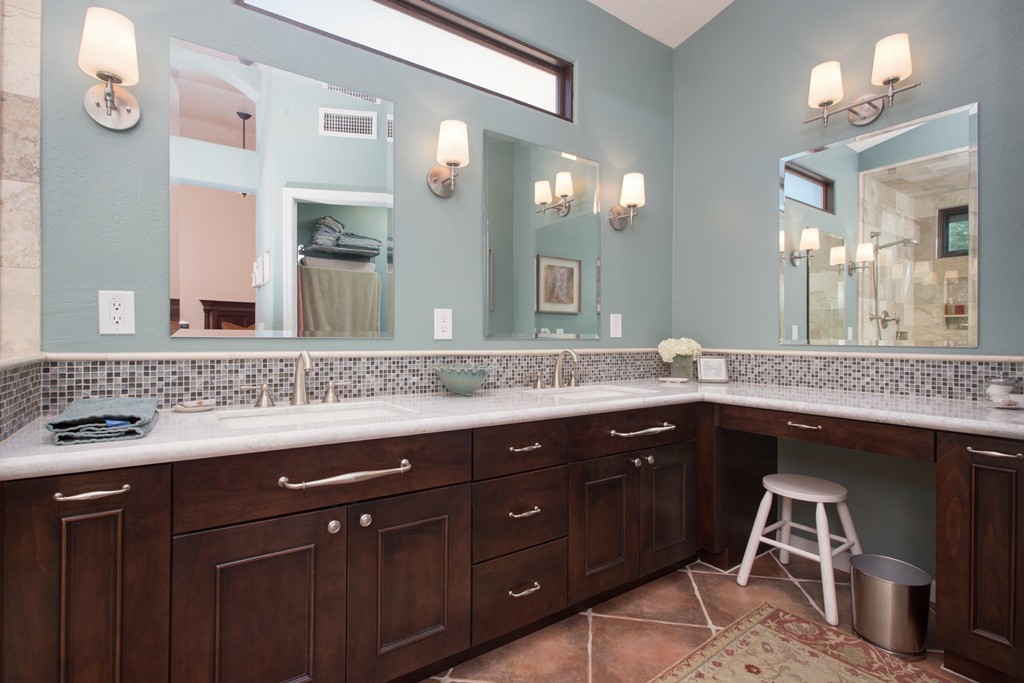
In practice that usually means a sconce on each side of the mirror, mounted so the center of the fixture sits about 60 to 66 inches off the floor, which puts the light at eye level for most people, and 3 to 6 inches out from the edge of the mirror. Too close and you get hot spots. Too far and the shadows creep back in.
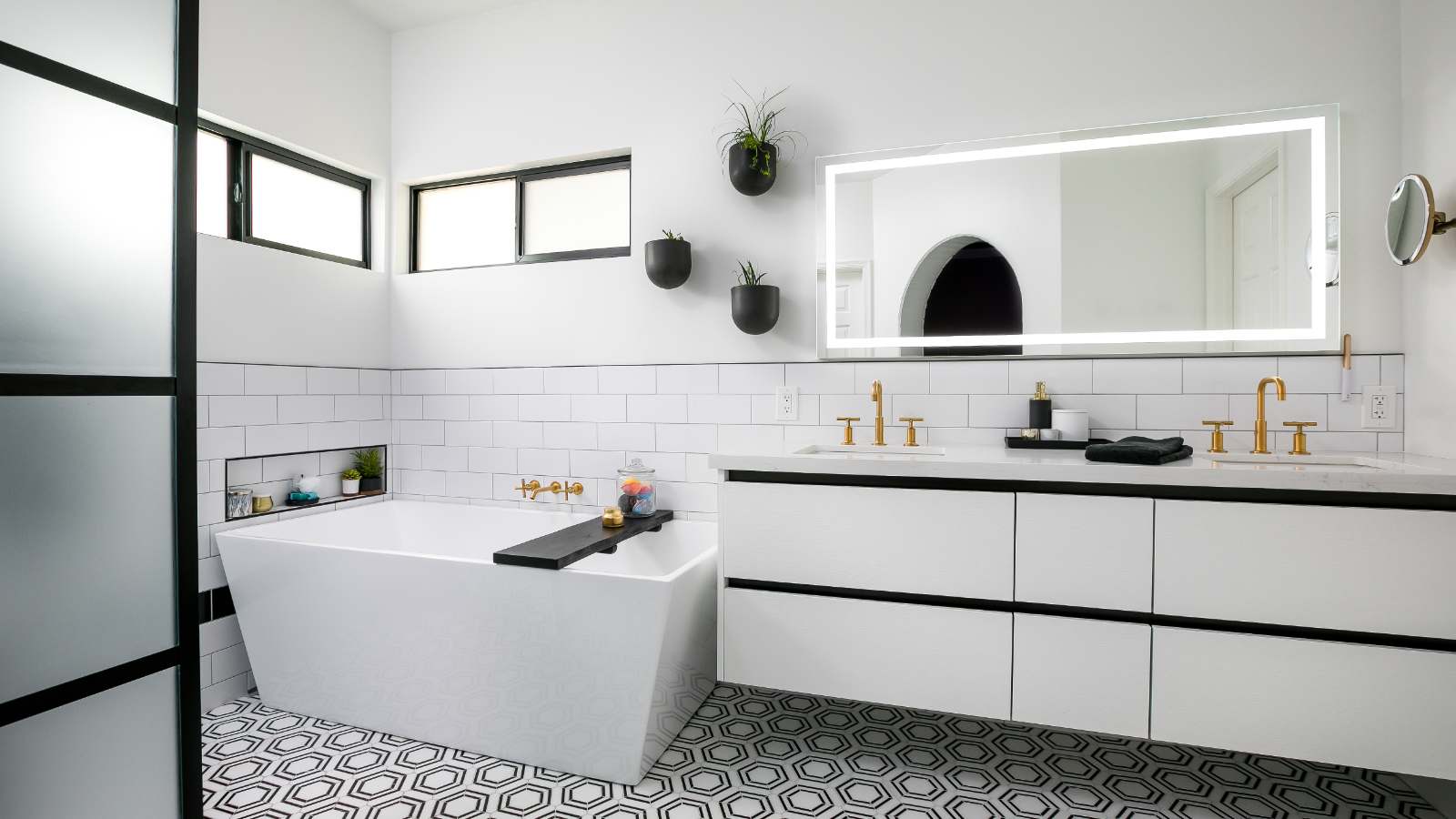
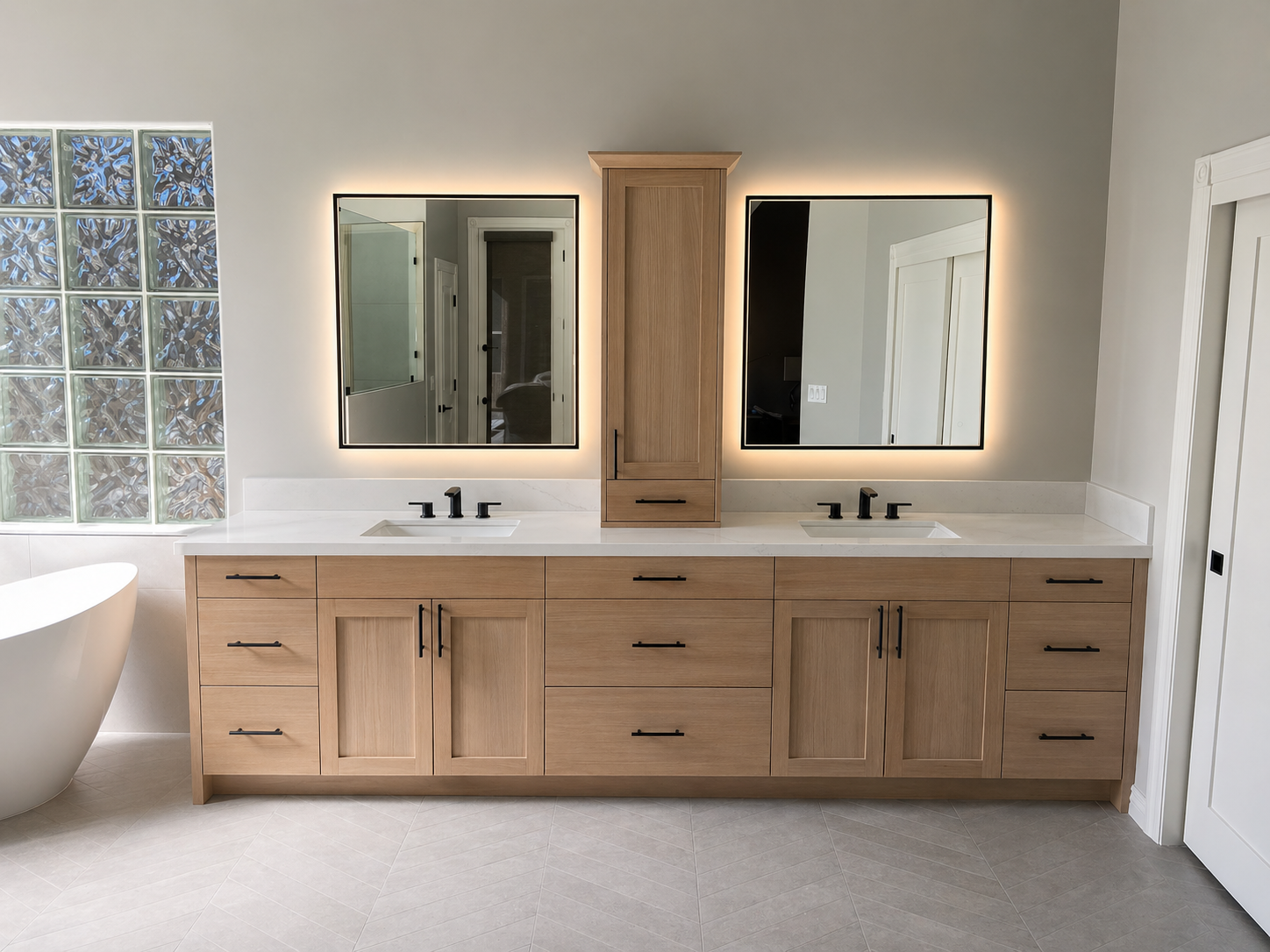
When wall space is tight, or the mirror is very wide, a lit mirror can help. Here is the honest version most people do not hear, though. A backlit mirror is mostly ambiance. That soft halo behind the glass is beautiful, but it usually does not throw enough light forward onto your face to be your main makeup light. A true illuminated mirror, with the LEDs built into the front edge, does light the face well. So the rule we follow is simple. Side sconces do the real work. A lit mirror is either a supporting glow or, when it is a front task mirror, a stand in where sconces will not fit. When the room allows, we use both.
What kind of light: color, accuracy, and control
Position is half of it. The light itself is the other half.
Color temperature is the warmth of the light, measured in Kelvin. Go too warm, down around 2700K, and skin can read yellow and dull. Go too cool, up around 5000K, and you get the flat, clinical light of a warehouse or a hospital. The number we land on for a vanity is 3500K. It reads natural while still feeling warm and inviting, which is exactly what you want on your own face.
Then there is color accuracy, measured as CRI, which is how truthfully a bulb shows color at all. A cheap LED can be the right warmth and still sit in the low 80s on CRI, and that is exactly where foundation stops matching, lipstick looks like a different shade in the car, and skin tones wash out. We do not go below 90, and we prefer 95 or higher, which is the range professional makeup artists work under because it comes closest to real daylight. Groups like the American Lighting Association treat this kind of accuracy as the standard for a room done right, not a luxury.
Last, controls. Your bathroom at six in the morning and your bathroom while you soak at the end of a long day want to be two different rooms, and one brightness setting cannot serve both. A dimmer is the least expensive upgrade in here and the one people forget. Beyond that, putting the vanity, the ceiling, and the shower on their own switches lets you light only what you need, and tunable fixtures can run cooler for daytime tasks and warmer at night. None of it is exotic. It just has to be planned before the walls close, which is the whole point of hiring a designer instead of leaving it to chance.
One ceiling light doing everything. A single fixture in the center of the room throws every bit of light down from above and guarantees a shadow on the face at the mirror.
Recessed cans placed over the mirror. It feels logical to put a light right above where you stand. It is the exact wrong spot. The light lands behind your line of sight and shadows the front of your face.
Bulbs at the wrong color temperature. Too cool and blue, and skin goes grey and clinical. Too warm at 2700K, and it turns yellow. Neither is the natural daylight look you want on your face.
Lights mounted too high above the mirror. A fixture bar way up near the ceiling is closer to overhead light than to side light, and it brings the overhead problem right back.
No dimmer anywhere. One setting, full blast, all day.
Letting the electrician place the fixtures. Where a sconce lands has to be coordinated with the mirror and the vanity, not decided on site with a tape measure. Good fixtures in the wrong spot still light the wrong thing.
None of these are exotic. They are ordinary, and they are in most bathrooms we are called to fix, including some that were remodeled only a few years ago by someone who never thought about the light.
One bathroom where the light was the whole fix
A few years ago we remodeled a large primary bathroom in Scottsdale for a homeowner named Patricia. When she called us, she thought this was a small job: swap the plain light bar over the mirror for a nicer one and be done.
What she actually had was one long mirror lit by a single fixture above it, plus four recessed cans in the ceiling, all of it pushing light straight down from overhead. The room was bright. It just was not lit for a face.
So we did not swap the light bar. We reworked the whole layout. We split the long vanity into two zones with two separate mirrors, and fit three wall sconces into that new arrangement so light reached the face from the sides. We added two illuminated mirrors for an even forward glow, replaced the four old cans with six canless LED recessed lights spaced for the new plan, and gave the shower its own dedicated light. One fixture trying to do everything became a layered plan where each light had a job.
Patricia's reaction is the part we remember. She had no idea lighting could make that big a difference. That is the whole point. It is almost never the makeup, and it is almost never about more light. It is the right light, put where it belongs.
What does better vanity lighting cost?
It depends on how far you take it, and the range is wide. On the light end, swapping a tired fixture above the mirror for a nicely made one starts around $500. On the other end, redesigning the layout into a full layered plan, new sconces, illuminated mirrors, canless recessed lights, and proper controls, runs well over $10,000. So the honest range is $500 to more than $10,000, and where you land depends on whether you are refreshing a fixture or rethinking the room.
What moves the number is not the bulbs. It is how much of the layout changes: how many fixtures, whether walls open up to move wiring, how many switching zones, and whether you are adding illuminated mirrors and layered ceiling and shower lighting. A fixture swap is inexpensive. A room that finally lights your face correctly is a design decision, and it is priced like one.
A few quick questions we get
Light on both sides of the mirror at eye level. It fills shadows instead of casting them, so you see your face the way the rest of the world will.
Warm white. Cool, blue light flattens skin tone. Warm white with high color accuracy shows your true color, which is the point.
Beside, whenever the wall allows it. Lights above the mirror bring back the overhead shadow. When side space is tight, a lit mirror is the next best answer.
It is one of the highest value, lowest cost pieces in the room. It lets one vanity serve a bright morning and a quiet evening.
Sometimes, and sometimes the wiring makes it bigger than a swap. That is a conversation worth having before you spend anything.
Lorrie Hochuli, Allied ASID, is the lead designer at Hochuli Design & Remodeling Team, a family design-build firm remodeling homes across the Phoenix valley. Vanity lighting is one of the details she plans into every bathroom, before the walls are ever closed up.
Planning a Bathroom Remodel
Let's design the lighting in from the start.
The best time to get the lighting right is before the walls are open, when a sconce location or a dedicated circuit costs almost nothing to add. If a remodel is on your mind, let's talk it through.
The 7 bathroom remodel mistakes we see most in Phoenix homes, from moving plumbing to undersized fans, and how to catch each one before it costs you...

 Lorrie
 Lorrie
 Scott Hochuli