
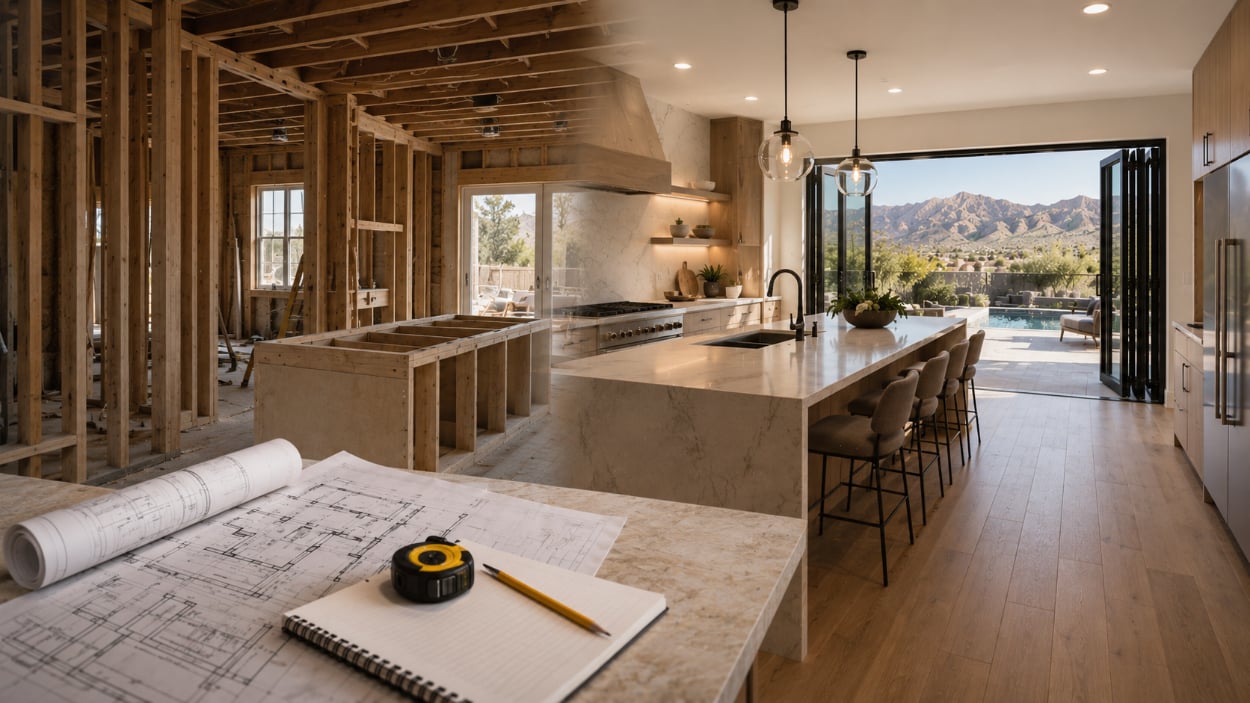
The honest timeline
How long does a remodel actually take?
Every phase, with real numbers, from the first phone call to the day you move back in. Including the job where we missed.
You've put this off for years. We get it.
The short answer
How long a Phoenix remodel takes, start to finish
A Phoenix kitchen takes 4 to 7 months from first call to move-back-in, and a bathroom runs closer to 3 to 5 months. Construction itself is the shorter half: 8 to 12 weeks for a kitchen, 4 to 8 for a bathroom, 3 to 6 months for a whole house. The rest is design at 3 to 6 weeks, the proposal at about a week, and a Phoenix permit review that runs 6 to 10 weeks before anyone touches your house.
Last updated August 2026. This page is reviewed and updated annually.
You are not really asking how long it takes
When somebody asks us how long a remodel takes, they are almost never asking for a number to write on a calendar.
They are asking how many months their kitchen is going to be a folding table in the garage. Whether they will be washing dishes in a bathtub through the holidays. Whether to tell their daughter to have the shower somewhere else this year. How much of their actual life this is going to cost them, and whether anybody is going to tell them the truth about it now or let them find out in week nine.
Nobody asks it that way, so most contractors answer the question that got asked. They give you the construction number, because the construction number is the short one and it sounds good on a phone call.
Here is the part almost nobody explains: most of the waiting happens before anyone touches your house. Design, a real proposal, and a city permit review all come first, and together they usually outlast the construction. A homeowner who knows that going in experiences a project that feels controlled. A homeowner who finds it out in month two experiences the same project as chaos.
So here is the whole thing, phase by phase, with real numbers on every one. Including the ones that are slower than you were hoping.
The whole path, start to finish
Every phase shows how long it takes on the outside of the card. Open a phase to see what actually happens inside it, and what tends to go wrong.
The first conversation
A phone call, or a visit to your home. Nothing signed and nothing owed.
- Two ways in. A phone call first if you want to size things up, or straight to an in-home visit if you already know you want to meet.
- Lorrie joins about half of the in-home visits we schedule. Whether the design side of the team comes along depends on where we are: still working out whether we should work together, or already past that and into the project itself.
- We look at what you want to do, what your house will actually allow, and roughly where the investment lands.
- You get a straight answer on fit. Our work starts at $50,000. If your project is smaller than that, we will say so and point you toward someone better suited, which is a better outcome for you than a polite maybe. If you would rather know roughly where you land before we ever talk, our pricing pages publish real ranges.
- The most useful thing you can bring is the list of everything you have been thinking about, including the maybes.
Design and planning
This is where the project gets decided. Drawings, selections, engineering, and everything that has to be settled before a real price exists.
- This phase is paid, and it is called the Project Development Agreement. It runs 5% of projected construction cost, with a $2,500 minimum. This is the path most of our projects take.
- Why it is paid: a complete plan set takes real design hours. Nobody can hand you a fixed price off a sketch, and the firms that try are quoting you a number they intend to correct later.
- Already have drawings from a designer or architect? You do not start here. You start with a Plan Review at 1%, $2,000 minimum.
- What gets decided: layout, structure, every finish and fixture, and anything that needs an engineer. Decisions made here cost a fraction of what the same decisions cost once walls are open.
- Not ready to commit to design? A $250 Feasibility Walk sizes up whether the idea works on your house first.
- How long this phase runs comes down to decisions. We will bring you the options and the recommendations, but the choices are yours, and the project moves at the speed those choices get made. Loving something and saying so moves it forward. So does saying it is not right and asking to see something else. What holds it up is neither.
- It also depends on how involved you want to be. Some homeowners hand us a blank slate and ask us to make every call. Others arrive with a list of things they will not compromise on and want a hand in every selection. Neither one is the wrong answer. Tell us which one you are and we will run the phase to match.
- The numbers, plainly. Hand us the wheel and this phase runs 2 to 4 weeks. Stay closely involved in every selection and it runs 4 to 12 weeks or longer. Most projects land at 3 to 6 weeks. And if you find yourself wanting to revisit every decision twice, that is worth saying out loud early, because it may mean we are not the right team for you, and finding that out now costs you nothing.
The Firm Proposal
One fixed number, built off a finished plan set. Not a range and not an estimate.
- The proposal is finished within a week of design and scope being complete.
- If you came through our design phase, the Firm Proposal is already covered. Its cost is included in the Project Development Agreement, so there is nothing further to pay at this step.
- If you are bringing us plans of your own, the Firm Proposal is 2% of projected construction cost, $4,000 minimum, on a complete set. If the drawings have to be finished first, it is 4%, $8,000 minimum. Projects above $1M are quoted individually.
- Every Firm Proposal opens with a plan check. If the set is not complete enough to price, the fee converts to a Plan Review and you pay only the difference.
- We do not price against incomplete plans. Three proposals off an incomplete set does not give you three prices, it gives you three guesses, and the lowest guess wins by leaving the most out.
- The number you get here is the number in the remodeling agreement.
Agreement and permits
You sign the remodeling agreement. Then the city takes the time the city takes.
- Where the time actually goes. The city takes 4 to 6 weeks for the initial review, then comes back with corrections or requests for clarification. Our team spends 1 to 3 weeks answering those. The second review runs another 1 to 3 weeks. Most projects land inside the 6 to 10 week window, and a set that draws heavy corrections can run past it.
- That pace is Phoenix. Other valley cities run their own.
- What actually triggers a permit. Structural changes, underground plumbing or gas, major electrical work, and anything that changes the footprint of the house. Cosmetic work that stays inside existing walls often needs no permit at all. If you are not sure which one your project is, sorting that out is one of the first things we do.
- This is the phase nobody enjoys and nobody can shorten by trying harder. It is also where a complete plan set pays for itself, because incomplete drawings get sent back and the clock starts over.
Ordering and lead times
Cabinets, windows, tile, countertops, appliances. Some of it ships in days and some of it takes months.
- This phase overlaps the permit review rather than following it, which is how the two longest waits get spent at the same time instead of back to back.
- We do not start a project until we know when every material will arrive. Starting demolition and then discovering a 12 week lead time is how a house sits open.
- Cabinetry typically takes 6 to 8 weeks. Windows run 4 to 8 weeks. Custom folding or stacking exterior doors are the long pole at 10 to 16 weeks.
- Tile, wood flooring, and carpet usually take 1 to 3 weeks when they ship from an out of state distribution warehouse.
- Quartz, granite, marble, and other slab materials run from a few days to a few weeks depending on what is available locally.
- Plumbing and electrical fixtures are a few days to a week, which is why they are almost never the thing holding a job.
- A selection changed late is the single most common reason a schedule moves, because the replacement item starts its own lead time over from zero.
Construction
The part everybody pictures when they think about a remodel, and the part that is easiest to predict once everything above it is done properly.
| Project | Construction time |
|---|---|
| Bathroom | 4 to 8 weeks |
| Kitchen | 8 to 12 weeks |
| Whole house | 3 to 6 months |
| Home addition | 4 to 6 months |
| Casita or guest house | 4 to 6 months |
- These are construction durations only. Design, proposal, permitting, and ordering all happen before this clock starts.
- Protection goes in before anything comes apart. ZipWall dust barriers and Ram Board over the floors, every time.
- You will know who is in your house and what they are doing, every day.
- Found conditions get disclosed the same day we find them, with a photo. Not at the end of the week and not buried in an invoice.
- If we make a mistake, we absorb it. It never becomes a change order. Ask every contractor you talk to that exact question.
- Change orders, when a real found condition causes one, typically run $2,000 to $5,000, and every one of them shows the revised project total so you always know where you stand.
- Staying in the house costs you schedule, not money. The price is fixed at the remodeling agreement and living here does not change it. Plan to leave for demolition and flooring, roughly 2 to 3 weeks, and if the project takes your only bathroom you are moving out.
Punch list and the day you move back in
The walkthrough, the last details, and the part of the relationship that does not end at the final payment.
- We aim for a punch list of nothing. The goal is to find the items needing attention before the last nail goes in, so they get handled while we are still putting the finishing touches on the space rather than after you have moved back into it.
- We walk the whole project with you and write down everything, including the things you feel awkward mentioning. Especially those.
- Punch list items typically take 1 to 5 days to close out.
- Occasionally something turns up late, a cabinet door that arrived damaged for instance. We order the replacement the day we spot it, and we do not hold up your move back in waiting for it.
- Everything we touch carries a two year warranty. And more than once we have covered something past that window, because it should have lasted longer than it did. That is a judgment call rather than a policy, but it is the call we tend to make.
- If something comes up a year later, you call us. That is the part of this business most people find out about too late for it to matter.
Where we buy the time back
Some of the wait belongs to the city and some of it belongs to a factory in another state, and neither one cares about your schedule. But a fair amount of what looks like waiting is really just sequencing, and sequencing is the part we control.
The floor goes in before the cabinets do
Bellmont cabinetry runs 6 to 8 weeks, and most crews treat that as eight weeks of nothing happening in your kitchen. We order the toe-kick base detached, and it arrives on its own in about two weeks. We set it and level it exactly where the cabinets will land, run the flooring right up to it, and get trim and paint done while the boxes are still in production. When the cabinets show up they drop onto a base that is already dead level. The lead time did not change. What happened during it did.
Lower cabinets first, so the countertop clock starts sooner
Countertops cannot be templated until there is something to template against. So on most projects we set the base cabinets first, get the counters measured and into fabrication, then install the uppers while the slabs are being cut. It saves the 2 to 5 days that most projects lose waiting on trim details the countertop never needed.
Cabinet handles should not be able to delay cabinets
Where it makes sense, we finalize and order the long lead items early and keep working through countertops, backsplash, flooring, and fixtures while the slow things are already in production. When we go that route you are invoiced for those items directly, and the order goes in once payment clears, which means you own the cabinets or the windows from the moment they are ordered. That holds whether or not you go on to sign a remodeling agreement with us. Ordering early buys back weeks. It does not buy us leverage.
What actually moves a timeline
Almost none of it is the crew working slower. When a project runs long it is usually one of these six. Half are settled before anyone picks up a hammer, and the other half get decided together once we are underway.
A selection changed late
The most common one by a wide margin. Swapping a tile or a fixture after it is ordered restarts that item's lead time from zero, and everything scheduled behind it moves with it.
Decisions that sit
Design does not run on our clock, it runs on yours. A choice that waits two weeks for an answer pushes the whole project two weeks, and it happens quietly enough that nobody notices until the end. The same thing happens mid-build: when you ask for something extra and we price it, the order does not move until the answer does.
A plan set that draws heavy corrections
Incomplete drawings come back from the city with a list. Answering it and going through a second review is how a 6 week permit becomes a 12 week permit. It is also the clearest argument for paying for a complete set up front.
Scope added mid-build
While-you-are-here additions are often worth doing, and they are always worth deciding early. Added in week six they cost less than doing them later as their own project, and they still move the finish date.
A day off is rarely one day
Ask us to skip a Friday or wrap early for a party. That is a fair thing to want and you should say so. Just know what it costs, because trades are booked in sequence. If the tile crew misses their window, their next opening might be nine days out, and everyone scheduled behind them moves too. Tell us early and we can usually build around it. Tell us that morning and usually we cannot.
Found conditions
Older Phoenix homes keep secrets, and some of them only show up once a wall is open. We disclose them the same day with a photo, but a real structural or plumbing surprise takes the time it takes. This is the one nobody gets to control.
The part most contractors leave out
We told a homeowner nine to ten weeks. It took twelve.
Chandler. 2,800 square feet. We moved their kitchen out to the garage so they could stay in the house, and put the laundry back on line every Friday so life kept working. And it still ran about two weeks past what we told them at the start.
We are putting that here on purpose. Every timeline on every contractor's website is the best case. Yours might be too, and it might not. The ranges above are real numbers from real jobs, which is exactly why one of them has to be a job that went long.
A contractor who has only ever finished early has not built very much.
What homeowners say about how we run a project
★★★★★ 4.9 stars across 100+ verified reviews on Google, Houzz, and GuildQuality
"We were scared to remodel because we'd had a bad experience in the past. We were blown away by the amount of information on their website about pricing, process, and timing. The construction was smooth because of the daily communication. The new kitchen turned out just as we had hoped."
Sarah R. · Phoenix kitchen remodel"From start to finish, their communication was exceptional. We always knew what was happening and what to expect next. They stuck to the proposed budget and timeline, which gave us so much peace of mind. Lorrie transformed our dated bathrooms into spaces we love."
Jessica O. · Scottsdale bathroom remodel"Always insightful and with great taste, the projects are on time and exceed our expectations. I highly recommend!"
Julie · Tempe"This is our second remodel with Lorrie and Scott. We added 900 square feet, redid the kitchen and flooring, changed the floor plan, and they coordinated seamlessly with our pool builder doing the backyard at the same time. It turned out better than we could have imagined."
Jenny E. · Scottsdale whole home remodel
Questions we get about timing
Construction runs 8 to 12 weeks. Start to finish, including design, the proposal, permitting, and ordering, a Phoenix kitchen typically takes 4 to 7 months from your first phone call to the day you move back in.
Construction runs 4 to 8 weeks, which usually puts the whole project in the 3 to 5 month range once design and permitting are counted. A bathroom that keeps its plumbing where it is moves faster than one that relocates a drain.
Three things happen first. Design and planning takes 3 to 6 weeks on average. The Firm Proposal is written within about a week of design being complete. Then the City of Phoenix takes 6 to 10 weeks to review the permit, which nobody can shorten.
Material ordering runs alongside permitting rather than after it, which is how the two longest waits get spent at the same time instead of back to back.
Usually yes, and it costs you schedule rather than money. The price is fixed at the remodeling agreement and staying does not change it. What it changes is sequencing, because working around an occupied house takes protection and staging that an empty one does not.
Plan to leave for demolition and flooring, roughly 2 to 3 weeks. And if the project takes your only bathroom, you are moving out. The constraint is plumbing, not project size.
A selection changed after it was ordered. Swapping a tile, a fixture, or a cabinet finish restarts that item's lead time from zero, and everything scheduled behind it moves too. Second most common is a decision that sits waiting for an answer, because design runs on the homeowner's clock rather than ours.
If it involves structural changes, underground plumbing or gas, major electrical work, or anything that changes the footprint of the house, yes. Cosmetic work that stays inside existing walls often needs no permit at all. Sorting out which one your project is happens early, before it can surprise anyone.
Yes. A 2,800 square foot Chandler project we quoted at nine to ten weeks took twelve. We publish that here rather than leaving it out, because the ranges on this page are real numbers from real jobs, and a set of real numbers has to include the ones that went long.
Two years on everything we touch. More than once we have covered something past that window because it should have lasted longer than it did. That is a judgment call rather than a policy, but it is the call we tend to make.

Written by Scott Hochuli
Founder and Author of Crush Expectations. Scott has been remodeling homes in greater Phoenix since 1992 and founded Hochuli Design & Remodeling Team with Lorrie Hochuli in 2001. Past President of the Greater Phoenix NARI chapter. Arizona ROC 173428. The durations on this page come from Hochuli project records rather than from industry averages.
Keep reading
Want a real timeline for your project?
Not a range off a website. A conversation about your house, your scope, and what the calendar actually looks like from here.
Stop dreading it. Start enjoying it.
Let's Start the Conversation